
B2B Sales: A Method for Web and Digital Agencies
B2B sales for web, SEO and Ads agencies: sales cycle, decision-makers, prospecting through signature, and French outreach and privacy rules to know in 2026.

In short
- B2B sales is business-to-business selling: longer cycles, more stakeholders, and an ongoing relationship.
- For an agency, the best entry point is a concrete, verifiable issue on the prospect's site, SEO, ads, or Google reviews in your local market.
- The process breaks down into six steps: lead generation, qualification, outreach, objections, negotiation and closing, and retention.
- On the rules side, phone solicitation reform in force since 11 August 2026 targets consumers; outreach to a professional about their business can rely on legitimate interest, with clear notice and a simple opt-out.
- A tool that automates research, audit, copywriting, and follow-up frees the time agencies should spend on what they actually sell: meetings.
B2B sales means selling to a business rather than an individual. For a web agency, studio, freelancer, or SEO and Ads agency, it means convincing the owner of a small or mid-size business, often the sole decision maker, to hand their site, search visibility, or advertising to an outside partner. What changes everything: you are not selling to someone who is already looking; you go after businesses whose need is already visible, and you show up with a precise diagnosis instead of a generic pitch. That is exactly what AutoLeads, our prospecting tool, does: it finds businesses in a trade within a city, surfaces gaps in their online presence, enriches them with contacts, and drafts the message sequence built on those gaps.
What B2B sales covers
B2B sales are sales from one business to another. SAP cites examples such as professional software licenses, industrial machinery, consulting services, cloud or SaaS subscriptions, wholesale trade, and marketing services. Your agency falls in the last category: you sell a service to an organization that uses it to run its own business.
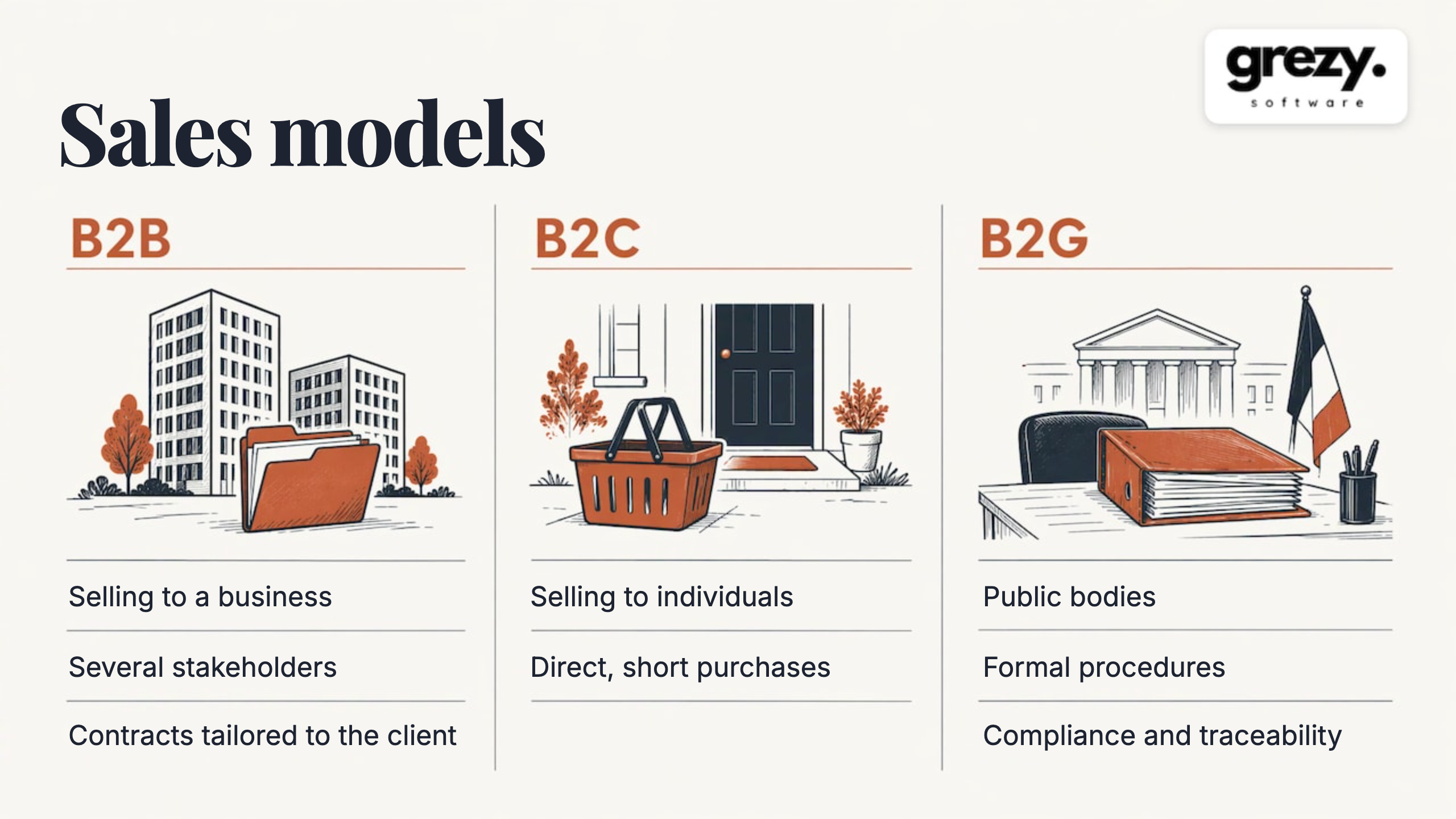
Two other cases are worth separating. B2C targets individuals, with purchases that are more direct and shorter. B2G targets public bodies, with formal procedures, tenders, and compliance and traceability requirements, as Generix summarizes. B2B often involves several players and contracts tailored to the client.
For an agency that targets local businesses, the playing field is B2B: the plumber in Lyon, the restaurant in Bordeaux, and the dental practice in Nantes are all companies, and whoever signs the quote commits company budget, not personal budget.
What makes B2B sales different
Longer purchases and more decision makers
France Num, the public digital support service for businesses, notes that B2B purchases usually take longer and involve more decision makers, with cycles that can run several years in some sectors. For very small businesses, the cycle is much shorter than in industry, but the principle holds: the person who replies to your first message is not always the one who signs.
France Num recommends identifying roles in the buying decision, the final decision maker, and the client's needs. In a very small business, the decision maker is usually the owner. In a company with a few dozen employees, a marketing manager or partner may shape the choice, and the owner approves it.
A relationship, not a one-off transaction
Again according to France Num, business-to-business selling is a personalized, ongoing relationship: understanding needs and knowing who decides builds trust and retention. For an agency, that is good news. A rebuilt site, a local SEO contract, or a Google Ads campaign extend into maintenance, optimization, and new projects. The first contract matters less than the relationship it opens.
Buyers who compare
An owner who receives your message compares it with what they already have: a cousin who built the site, the previous agency, a provider someone recommended. What stands out is not your generic credentials, but proof you looked at their business. A message that says "your Google listing has 12 reviews and your site takes several seconds to load on mobile" does not look like any other.
The stages of a B2B sales process
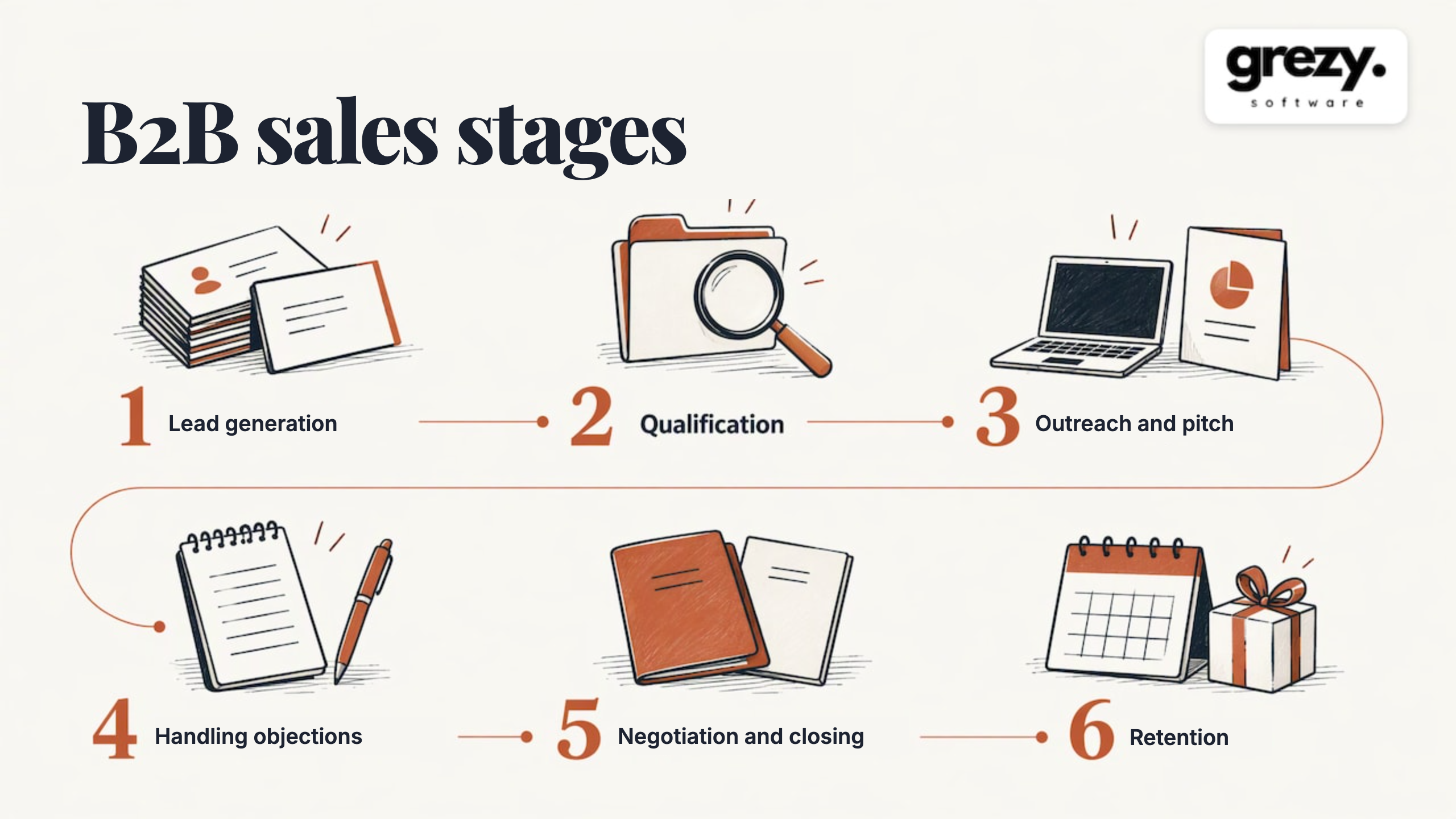
The classic model, described by Asana, runs through lead generation, qualification, outreach and presentation, handling objections, negotiation and closing, then retention. Here is what each stage asks of an agency, and where it often stalls.
1. Generate leads
A lead is a business that may need your service. Adie, a microcredit association that publishes practical guides for new business owners, advises starting B2B prospecting with a targeting strategy, then researching companies and contacts, and finally making contact.
For an agency, targeting comes down to two choices: a trade and an area. "Plumbers in Lyon," "restaurants in Bordeaux," "real estate agencies in Loire-Atlantique." The more specific the trade, the more your pitch and case studies resonate with the prospect.
What goes wrong: bought or hand-built lists go stale quickly, and compiling 200 businesses by hand, address by address, with sites and contacts, takes days. AutoLeads does this research in real time on the web and Google Maps: you pick a trade and a city, and the tool finds matching businesses.
2. Qualify
Qualifying means deciding who deserves a message and which one. Useful criteria for an agency can be checked online:
- an outdated, slow, or mobile-unfriendly site;
- weak rankings on the obvious trade-plus-city query;
- no paid ads while local competitors run them;
- few Google reviews, or reviews left unanswered;
- abandoned social profiles.
What goes wrong: qualifying ten sites by eye is feasible; two hundred is a full-time job. AutoLeads audits each company's online presence (site, SEO, ads, Google reviews, social) and shows you the result lead by lead. You rank prospects by the gap that matches your offer: a site audit for a web studio, missing ads for a Google Ads agency.
3. Identify the decision maker and make contact
France Num stresses finding the final decision maker. A message to a generic "contact@" address is rarely read by the right person. AutoLeads enriches each lead with contacts: owner, email, phone, and LinkedIn when available.
The first message should fit in a few lines: a precise finding, what it costs the business, and an offer of a short conversation. For each company, AutoLeads drafts a sequence of emails and LinkedIn messages grounded in real gaps found in the audit. The agency arrives with a concrete diagnosis, not copy-pasted text.
France Num also recommends combining several channels: website, professional events, phone, video calls, on-site visits. For agency prospecting, a simple mix works: an email, a LinkedIn message a few days later, then a call once the owner has seen your name.
4. Handle objections
Adie advises preparing talking points tied to identified needs and objection responses before the first contact. Objections from small business owners repeat:
- "I already have someone for my site." Answer with numbers from your audit: what is not working today, and what you would fix first.
- "I do not have the budget." Offer a smaller scope, a detailed audit, or a short first engagement.
- "My clients come through word of mouth." Show what people who do not know them yet see when they search the trade in their city on Google.
What goes wrong: improvising. With an audit in front of you, you respond with facts about the business, not generalities.
5. Negotiate and close
A clear proposal, written scope, price, and timeline. In a very small business, the gap between the first meeting and signature is often counted in weeks, not months, if you follow up. Follow-up is the step agencies forget most: they send one message, get no reply, and move on.
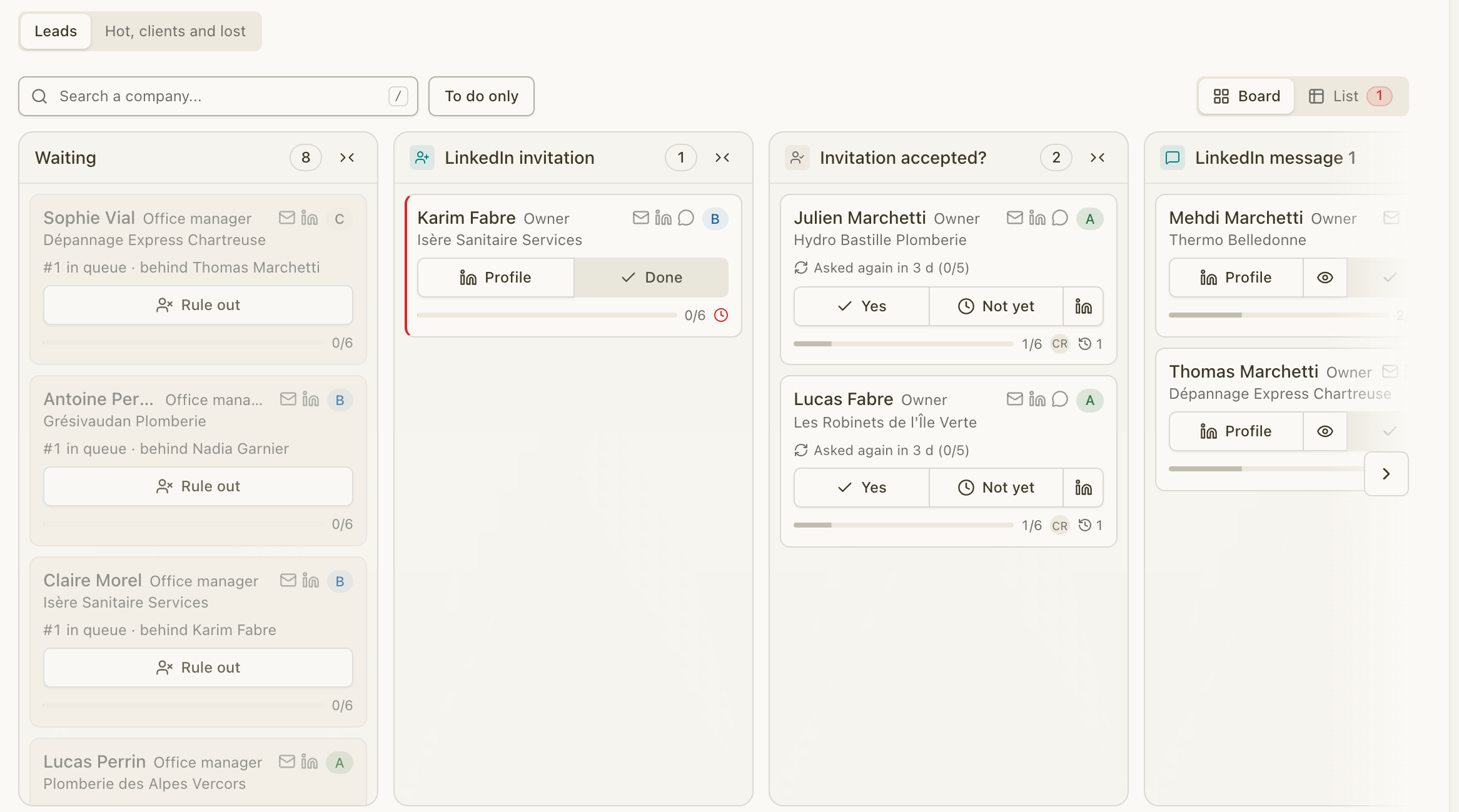
AutoLeads sends the sequence in weekly waves from the agency's mailboxes and accounts. Replies land in a built-in CRM as tasks: you see who answered, who needs a nudge, who is ready for a meeting. If you prefer your own stack, leads can sync to HubSpot or export as CSV.
6. Retain
B2B sales do not end at signature. A happy client renews maintenance, adds a campaign, or refers a peer. That is the durable answer to relying on word of mouth alone: referrals become a complement to a steady flow of new clients, not the only source.
As sales grow, operations follow: project tracking, client support, admin. Some growing companies choose to outsource support teams to absorb that load without stalling commercial development.
Prospecting within French law
B2B prospecting follows precise rules, and they shifted in 2026. Three points to remember.
Phone. According to the CNIL, from 11 August 2026, commercial calls to consumers generally require prior consent, with exceptions, including some calls tied to an existing contract. This reform targets consumers: an owner called about their professional activity is not in that bucket.
Profession-related prospecting. For B2B outreach related to someone's work, the CNIL states that legitimate interest may be used as the legal basis. The professional must be told about the approach and able to object easily. In practice: your message says who you are, why you are writing to this person, and how to stop further contact. Honor an opt-out request immediately and keep a record.
Email. CMS's analysis notes that the law of 30 June 2025 replaced, for consumer calls from 11 August 2026, the Bloctel opt-out regime with prior consent, and that this phone reform must not be confused with rules for electronic prospecting, which have their own regime and exceptions. For your specific case (target, message, databases), have your practice validated by a lawyer or your data protection officer if you have one.
How many businesses to contact to fill a calendar
There is no universal ratio, and circulated response rates depend on trade, message, and area. The most reliable approach is to model a funnel on your own activity: qualified leads per week, replies, meetings, signatures. Each week of sending gives data to adjust targeting and copy.
One workable method: pick a trade and city for a first wave, note the most common gap in the audit, write your message around that gap, and compare with a second wave on another gap. In a few weeks, you know which angle fills the calendar. AutoLeads' weekly sends make that comparison straightforward.
From idea to steady prospecting
AutoLeads runs on a monthly subscription, with credits consumed based on lead volume and enrichments enabled. Three plans are offered: Starter at €249 per month, Growth at €499 per month, and Scale at €899 per month. The "We call for you" option, with no published price, adds outsourced appointment setting as needed. You choose the tier that matches how many leads your agency can handle each week, and you create your account on the AutoLeads plans page.
Our view
An agency does not lack skill; it lacks a steady flow of meetings. Too many studios and freelancers depend on word of mouth, freelance platforms, or tenders: three sources they do not control.
We believe an agency's B2B sales should start with what is visible about the prospect on the web. A slow site, a thin Google listing, no ads: those gaps exist, can be measured, and give a reason to write. That is why AutoLeads audits each business before drafting a single message, and builds the sequence from those real gaps.
We also believe a founder's time is worth more than list building. Finding companies, locating the owner, writing ten message variants: all of that can be automated. What cannot be automated is the conversation with the owner, and that is where the agency should spend its energy.
Tom
Frequently asked questions
Sources
- B2B sales: definition, SAP France(opens in a new tab) accessed November 22, 2026
- B2C, B2B, B2G: definition and explanation, Generix(opens in a new tab) accessed November 22, 2026
- Using digital tools to grow sales, France Num(opens in a new tab) accessed November 22, 2026
- B2B vs B2C sales: definition and best practices, Asana(opens in a new tab) accessed November 22, 2026
- Prospecting B2B clients, Adie practical guide(opens in a new tab) accessed November 22, 2026
- Commercial prospecting by phone, CNIL(opens in a new tab) accessed November 22, 2026
- Commercial prospecting and GDPR: tightening the legal framework, CMS(opens in a new tab) accessed November 22, 2026