
Automated prospecting: the guide for web agencies
Automated B2B prospecting for agencies and freelancers: what you automate, how a campaign is built in six steps, the legal framework, and KPIs to monitor.

In short
- Automated prospecting handles repetitive work (list building, enrichment, sending, follow-ups, CRM entry). Qualification and conversations stay with you.
- A campaign that gets replies is built in six steps: target, audit, contacts, sequence, sending, and handling responses.
- A message that cites a real flaw on the company's website or Google Business Profile stands out from a generic message sent to a purchased list.
- In B2B, email prospecting still has rules: use a professional address, keep the subject relevant to the recipient's trade, inform the recipient, and offer an easy opt-out.
- Steer the campaign with a few metrics: replies, meetings booked, cost per meeting, and signed deals.
Automated prospecting means handing software everything that happens before a prospect's first reply: finding companies, finding their contacts, spotting their weaknesses, drafting and sending messages, and following up. You keep what closes deals: choosing the target, replying, booking the meeting. For a web, SEO, or Ads agency targeting local TPE/PME (France's very small and small-to-medium enterprises), the most effective approach is to start from a visible flaw (outdated site, thin Google profile, no advertising) and write to the business about that flaw. That is the logic behind AutoLeads, Grezy's prospecting tool: we search for "plumbers in Lyon" or "restaurants in Bordeaux," we audit their online presence, and we draft sequences from what we found.
What automated prospecting really covers
The term is broad, and top search results mix three topics: marketing automation (emails triggered by behavior from someone already in your database), LinkedIn automation (invitations and messages sent in series), and automated outbound prospecting (reaching companies that do not know you yet). For an agency looking for clients, the third one matters. Your contact database is empty or too small: you need to build the list first.
A complete automated prospecting chain links five steps:
- Sourcing: build a list of businesses in a trade for a given city.
- Enrichment: find the owner, their email, phone, and LinkedIn profile.
- Diagnostic: note what is wrong with each company's online presence.
- Sequence: write and send messages, then follow-ups.
- Tracking: capture replies and turn them into tasks for sales.
Market tools often specialize in one or two links: contact databases, cold-email senders, LinkedIn automations, CRMs. The agency ends up stitching together four subscriptions, exporting files from one tool to another, and writing every message by hand. The promised time savings disappear into plumbing.
What you automate and what stays human
The useful rule is economic: automate what repetition does not change in value, and keep in human hands what quality decides.
| Task | Automatable? | Why |
|---|---|---|
| Build and deduplicate the company list | Yes | The outcome is the same every time |
| Find the owner, email, phone | Yes | Repetitive, verifiable research |
| Flag site, SEO, and review weaknesses | Yes | Objective, measurable criteria |
| Draft a first message from those findings | Yes, with review | Content comes from the diagnostic, tone is yours |
| Send, space out, follow up, stop on reply | Yes | Pure execution |
| Choose trade and territory | No | That is your positioning |
| Reply to a prospect | No | The relationship starts here |
| Scope needs, quote, close | No | That is your job |
One watchpoint for agencies: automating a generic message only produces spam faster. Automation becomes useful when it enables personalization at scale, meaning each message includes a finding specific to the recipient company. That is why the diagnostic comes before drafting in our chain.
Building an automated B2B prospecting campaign, step by step
1. Pick a trade and a city, not "SMBs" in general
A campaign that works aims at a narrow segment: one trade, one area, one need you know how to solve. A Shopify web designer will look for artisan online shops with dated sites; a local SEO agency will target restaurants or trades with thin Google profiles; a Google Ads agency will go after businesses running no ads while competitors do.
The classic mistake is going broad to "see what responds." You end up with a message too vague to land with anyone. Start with a single trade-and-city pair, and launch the next only when the first has delivered its replies.
In AutoLeads, you choose a trade and a city, and the tool finds those businesses in real time on the web and Google Maps. You are not buying a static database: the list reflects companies as they appear at search time.
2. Audit each company's online presence
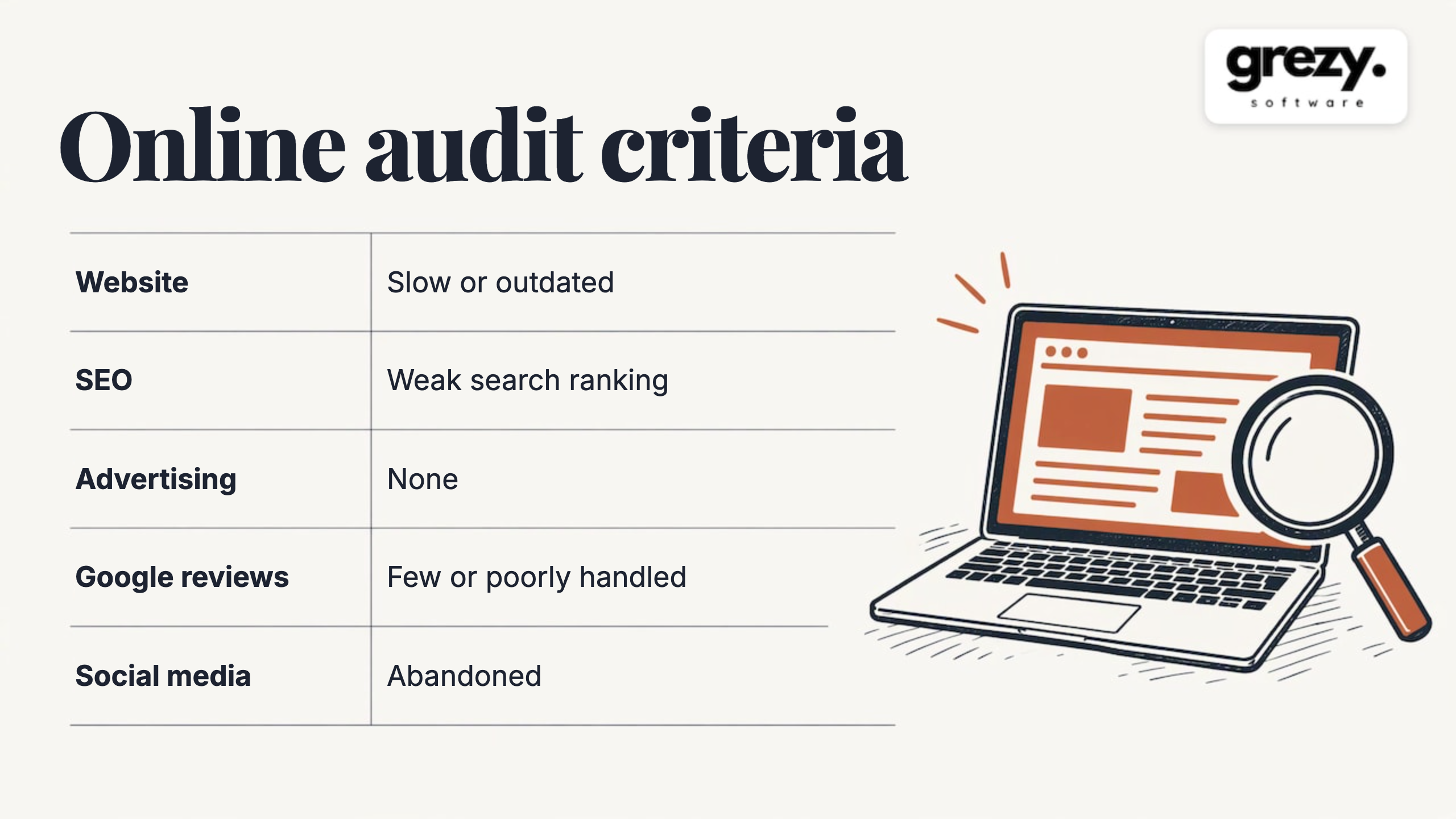
This step separates useful prospecting from mass outreach. For each business, note what a prospect could check in two minutes: a slow or outdated site, weak SEO, no ads, few or poorly handled Google reviews, neglected social accounts.
Doing that audit by hand takes ten to fifteen minutes per company, which caps one person at a few dozen prospects per week. Our tool runs that audit for every lead: site, SEO, ads, Google reviews, social media. You show up with a concrete diagnostic rather than a generic pitch, and that diagnostic feeds the message.
3. Find the right contact
In a TPE, the owner decides. Writing to a generic address like contact@ often reaches no one. You need the owner's name, professional email, a phone number, and their LinkedIn profile when it exists.
AutoLeads enriches each lead with those contacts when they are found. The nuance matters: no tool finds 100% of contacts, and a serious list accepts that some leads stay without email. Those can go through phone or LinkedIn rather than being dropped.
4. Write a multichannel sequence
A sequence is a set of messages sent on a schedule that stops as soon as the prospect replies. Three principles make it work.
- A specific finding in the first sentence. "Your site takes several seconds to load on mobile" beats "We help businesses grow."
- One ask per message. A fifteen-minute chat, not a quote.
- Several follow-ups and several channels. A first touch often gets no reply, not from lack of interest: the prospect is mostly busy. Spaced follow-ups and switching channel (email, then LinkedIn, then call) raise the odds of being seen at the right moment. Most reps quit too early: that is precisely the part automation keeps up without effort.
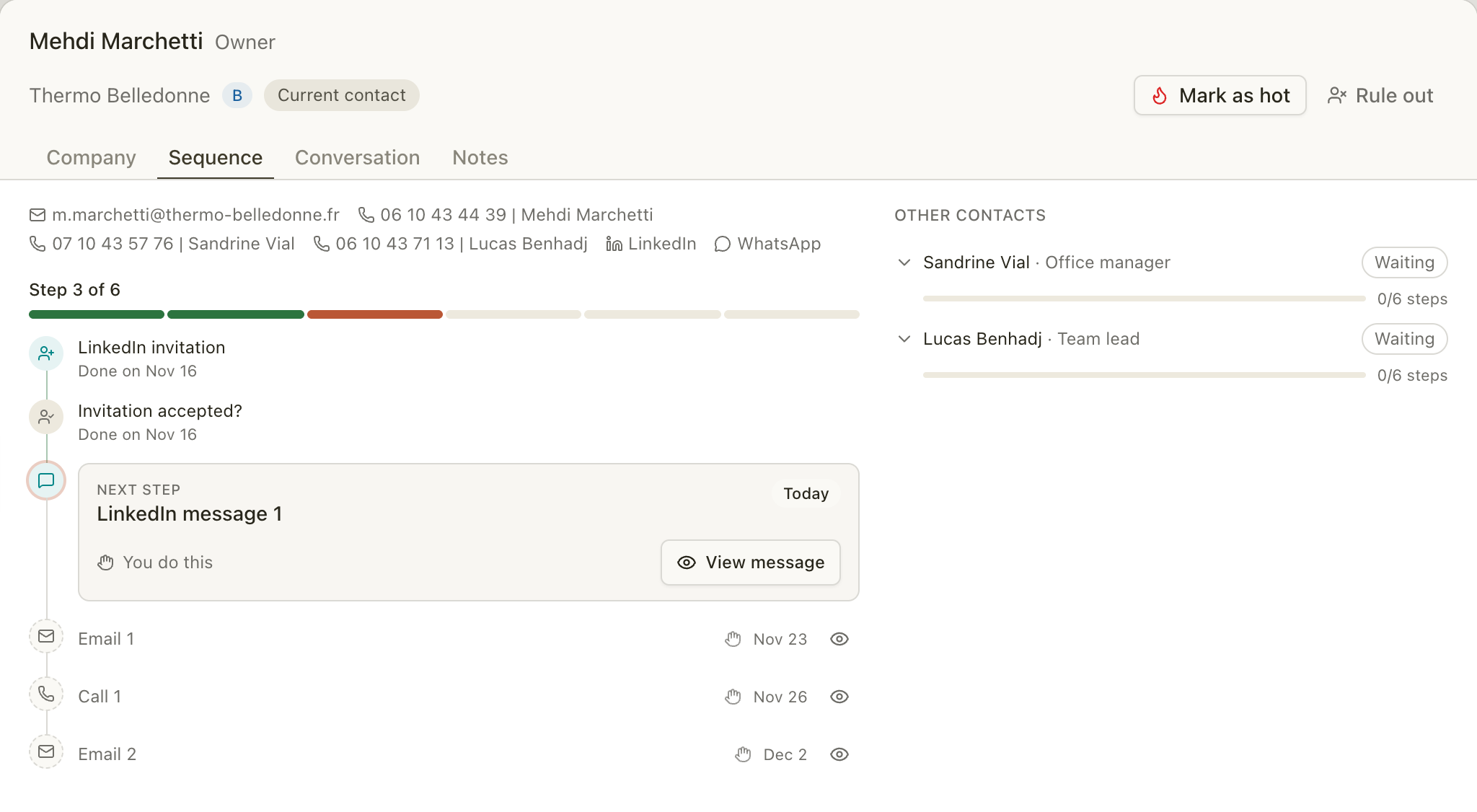
For each company, our tool drafts a sequence of emails and LinkedIn messages built on flaws found in step 2. You proofread, adjust tone, validate. Reviewing the first sends before letting the campaign run remains good practice whatever tool you use: a message with a typo sent to a hundred companies amplifies the mistake a hundred times.
5. Send in waves from your own mailboxes
Sending is where a campaign breaks technically. Hundreds of messages at once from a new mailbox land in spam, and a damaged domain takes a long time to recover. Gradual sending in regular waves protects sender reputation.
With AutoLeads, sends go out in weekly waves from the agency's mailboxes and accounts: the message comes from your address, signed with your name, not from an anonymous platform. If you prefer to keep your own sending tool, leads can also be pushed to HubSpot or exported as CSV.
6. Treat replies as tasks
A prospect who answers "not now, call me back in January" is a lead you must not lose. If replies sit in a shared inbox, they get lost. In AutoLeads, they land in a built-in CRM as tasks: reply, call, propose a slot. That is where the human takes over, and automated prospecting hands off to sales.
The legal framework for B2B email prospecting in France
Automating does not exempt you from the rules. They are looser in B2B than in B2C, but they still exist.
The principle is set out in Article L.34-5 of the French Post and Electronic Communications Code: direct prospecting by email, SMS, MMS, or automated calling generally requires the person's prior consent. There are two exceptions, including CNIL doctrine specific to B2B: you may write to a professional address if the message subject relates to the recipient's profession, and that tolerance applies only to email, not to automated systems such as fax.
What that means in practice for an agency:
- A subject tied to the profession. Proposing a site redesign to a tradesperson with an old site fits their activity. A message unrelated to their trade falls outside the framework.
- Inform and allow opt-out. Each message must make it simple to refuse further messages, and the person must know who is contacting them and how their details were obtained. When you rely on data from a third party, the information required by GDPR Article 14 must be provided from the first communication.
- Honor opt-outs. Anyone who asks to stop must not be contacted again, whatever sequence is running.
- Watch evolving guidance. Some lawyers point out that the CNIL's B2B exception appears neither in the e-Privacy Directive nor in the GDPR, so it could change. For a specific situation (regulated sector, large campaign, purchased list), seek advice from a lawyer or your organization's data protection officer.
The practical takeaway: a list built from real companies, messages tied to their activity, and a sequence that stops at the first reply or first refusal are the foundations of clean prospecting.
Which channels to combine
Email is the easiest channel to automate and the one that scales. It is not always enough: a local business owner reads little cold email and spends more time on the phone or LinkedIn. A guide to soft prospecting on LinkedIn stresses being visible before you reach out: a polished profile and steady posts make a connection message more credible.
A sensible mix for an agency:
- a first email centered on a specific finding;
- a low-key LinkedIn invitation a few days later;
- an email follow-up with something new (a figure, an example);
- a call for leads whose phone number you have.
Order and timing depend on the trade you target. A restaurateur is reachable at very different times than an accounting firm. On LinkedIn, stay within reasonable volumes: aggressive automation can lead to account restrictions, and a sequence that reads like a human writing beats a burst of invitations.
Measuring results without tracking the wrong number
An automated prospecting campaign is steered with four ratios, top to bottom of the funnel:
| Metric | What it tells you | If the number is low |
|---|---|---|
| Deliverability rate | Do your messages reach the inbox? | Technical issue: domain, send pace |
| Reply rate | Does the message resonate? | Revisit the finding, subject line, target |
| Meeting rate per reply | Can you turn interest into a meeting? | Revisit the reply and the offer |
| Cost per meeting | Is the campaign profitable? | Compare to the value of a signed client |
The number that really matters is the last one: what a meeting costs you, and what a signed client brings in. A subscription of several hundred euros per month is judged on that math. If an average client brings in several thousand euros for a site build or months of retainer fees, one win per quarter changes the equation. To define the right metrics in your own organization, this overview of B2B marketing KPIs for TPE and PME helps you pick what you actually use to decide.
Two habits avoid bad reads. Compare a campaign to the previous one in the same trade, not to a market average from an article. And wait until the full sequence finishes before concluding: follow-ups generate a large share of replies.
Your prospects are TPEs you still need to convince with numbers. A site that converts poorly is a sales argument for you: concrete levers to improve a site's conversion rate can support the proposal you make once the meeting is booked.
The mistakes that cost the most
- Aim too wide. A message for everyone reaches no one.
- Write without a diagnostic. The prospect spots a template instantly.
- Send everything the same day. Blast sending damages your domain reputation.
- Give up after the first message. Follow-ups are part of the method.
- Let replies go cold. A January callback should be a dated task, not a memory.
- Skip informing the recipient. Who you are, where their contact came from, how to opt out: those three belong in every sequence.
AutoLeads: the full chain for an agency
If you want to replace word of mouth, freelancer platforms, and RFPs with a steady flow of meetings with local TPE/PME, AutoLeads brings the steps above into one tool: real-time lists by trade and city, online presence audit, owner contacts, sequences drafted from findings, weekly sends from your mailboxes, built-in CRM for replies.
The monthly subscription runs on credits consumed according to lead volume and enrichments enabled. Three plans are published on Grezy's website: Starter at €249 per month, Growth at €499 per month, and Scale at €899 per month. An à la carte option, "We call for you," outsources meeting booking.
Our view on automated prospecting
We see automated prospecting as a way to give an agency back what it does best: talk about its craft to someone who needs it. The rest, finding, checking, drafting, sending, following up, should not fill your days.
What guided us building AutoLeads is a simple idea: a message is worth what it contains. "Hello, we help SMBs grow" contains nothing. "Your site is slow to load and your Google profile has few reviews" contains a fact the owner can verify and that justifies writing to them. Our tool audits first, drafts second, and the agency arrives with a diagnostic.
We also think agencies deserve better than stale databases. A purchased file shows companies as they were. Searching a trade in a city in real time starts from what exists today.
Finally, sending from your own mailboxes and accounts keeps the relationship in your name. Automation prepares the ground; the conversation stays yours.
Alexis
Frequently asked questions
Sources
- Direct commercial prospecting: a reminder of the rules (AGIL'IT)(opens in a new tab) accessed November 19, 2026
- Reusing data acquired from data brokers (Feral)(opens in a new tab) accessed November 19, 2026
- B2B commercial prospecting by email (Village de la Justice)(opens in a new tab) accessed November 19, 2026
- Soft prospecting on LinkedIn: the 2026 guide(opens in a new tab) accessed November 19, 2026
- B2B marketing KPIs: metrics that matter for a TPE/PME(opens in a new tab) accessed November 19, 2026
- Improve your site's conversion rate: 9 concrete levers(opens in a new tab) accessed November 19, 2026