
Scrape Google Maps to Find Businesses: 2026 Guide
Extract businesses from Google Maps: what you capture, technical limits, the legal framework in France, and how to turn a list into booked meetings.

In short
- Google Maps gives you one profile per business: contact details, website, reviews, opening hours. It does not tell you who decides, or who needs a site rebuild.
- Manual extraction hits technical ceilings: 60 results maximum per search on the official place search service, plus CAPTCHAs and blocks at higher volume.
- In France, scraping is not banned as such, but B2B prospecting is regulated: data minimization, disclosure on first contact, and a working opt-out.
- A list alone does not fill a calendar: a site audit and a personalized message separate an ignored email from a booked meeting.
- AutoLeads finds businesses by trade and city, audits them, enriches the data, and writes outreach sequences from your mailbox.
Scraping Google Maps means automatically pulling the business listings shown for a query like "plumbers in Lyon": name, address, phone, website, rating, and reviews. For a web agency, the raw output is only a starting point: a list of names does not say who needs a new site or whom to contact. The value comes from what you add next: a site audit, the owner's name, a verified email, and a message about real weaknesses in the business. That is what AutoLeads, Grezy's prospecting tool, chains together for you.
What Google Maps gives a web agency
Each Google Maps listing is a small public dossier. According to a guide on the topic, you get business names and addresses, phone numbers, reviews and ratings, opening hours, and websites. If you sell websites, SEO, or local ad campaigns, four fields really matter:
- The website: missing one is already a signal. When one is there, you can check speed, mobile fit, and SEO.
- Rating and review count: a business at 3.2 out of 5 with few reviews has an obvious local reputation gap.
- Category: use it to segment (plumbers, restaurants, physiotherapists) and tailor the pitch.
- Phone: useful, but it usually reaches reception, not the decision-maker.
What is missing is obvious right away. No listing shows the manager's name, a personal work email, or why the company should change sites. That takes a second pass, often longer than extraction itself.
How to search and export businesses by trade and city
The logic is always the same: a query that combines a trade and an area, then collect the listings that appear. Approaches fall into three types.
- Manual search: you type the query, scroll the list, and copy. Fine for ten listings, unworkable for a whole French département.
- Browser extensions and no-code tools: they automate scrolling and export a spreadsheet. You still handle verification, enrichment, and copywriting.
- The official API or a custom script: more flexible, but it means development, pay-per-volume billing, and quota management.
With AutoLeads, you pick a sector and a city, for example "plumbers in Lyon" or "restaurants in Bordeaux". The tool finds those businesses in real time on the web and Google Maps, without a static database, then moves straight to audit and enrichment. You have no spreadsheet to clean and no script to maintain.
Technical limits of manual extraction
Anyone who has tried to pull hundreds of listings has hit the same walls. A technical guide covers the main ones:
- Results depend on the IP location used for the query. A search from another country or network can return a different list than a client in Lyon would see.
- Repeated requests from one IP trigger CAPTCHAs, empty lists, and HTTP 429 errors, the status code for too many requests.
- The official API text search service returns 20 results per page, with a maximum of 60 results for a single search.
- Free API quotas are capped each month and vary by data type.
The 60-result cap has a practical effect: to cover a large city, split the search by neighborhood, sub-category, or postal code, then deduplicate. That is exactly what an agency does not want to manage. Your time is worth more than a script's.
The legal framework in France: what to know before you prospect
The topic is serious and worth stating clearly. Scraping is not banned outright. Per the CNIL practical sheet from June 2025 (France's data protection authority), lawful basis and safeguards drive compliance: data minimization, respect for robots.txt, informing people on first contact, and an opt-out that works. Legitimate interest can ground collection of publicly accessible data.
Three layers stack up, per a legal analysis of scraping in France:
- Access must be lawful: no bypassing protections. Article 323-1 of the French Criminal Code punishes fraudulent access to a system.
- Data must rest on a lawful basis under the GDPR, with notice to the people concerned.
- Reuse must respect intellectual property and the service's terms of use. Taking a substantial share of a protected database exposes you to database producer rights, with penalties of up to €300,000 in fines and three years in prison.
In B2B prospecting, the golden rule is relevance: a message about a company's website when that site is outdated ties directly to its activity. A generic blast to a whole list does not. Collect only what you need, say who you are and why you are writing, and offer a simple way to stop contact.
For a specific doubt about your situation (a bought file, a franchise list, consumer data), talk to a lawyer or your organization's data protection officer. Prospecting consumers follows stricter rules than prospecting businesses: this guide covers outreach to small and mid-sized businesses.
Check and organize extracted data
Raw extraction contains errors. Before you contact anyone, run every list through five checks.
- Duplicates: the same business sometimes appears under two categories or two addresses. Deduplicate on website or phone.
- Closed or off-target businesses: remove listings marked permanently closed, franchises where decisions are national, and companies that are already clients.
- Real website: confirm the URL leads to a site, not a social profile or a directory page.
- Decision-maker: identify the owner. Writing to a generic inbox cuts response odds.
- Verified email: an invalid address hurts your sender reputation. Check each address before sending.
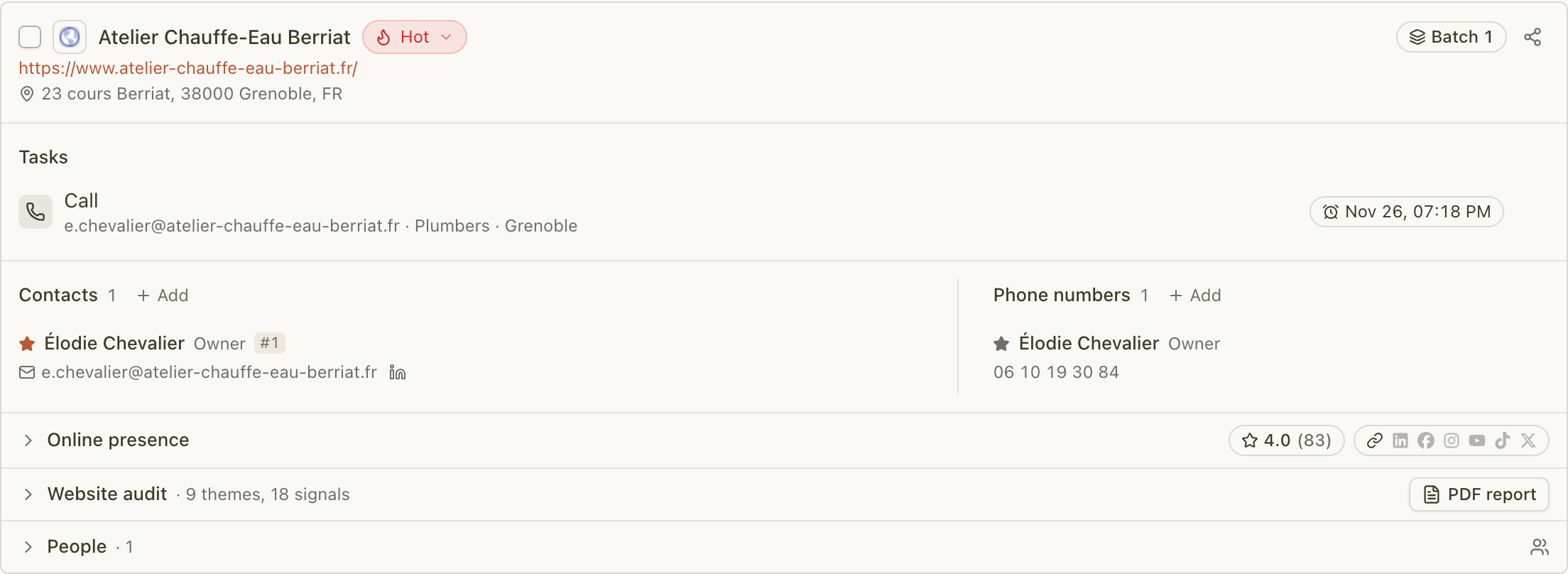
Then sort by priority: at the top, businesses whose need is most visible, for example a slow site, no mobile version, or recent negative reviews. At the bottom, those with a solid presence. Doing this by hand for 300 companies takes days. In AutoLeads, the online presence audit (outdated or slow site, weak SEO, Google reviews, social profiles) runs on every lead, and enrichment adds the owner, a verified email, and a phone number.
From list to meeting: the message makes the difference
Here is a concrete example. You extracted 120 restaurants in Bordeaux. Generic version: "Hello, we build websites. Would you like a quote?" Likely reply: none. Audit-based version: "Hello Ms. Martin, your restaurant's site takes more than six seconds to load on mobile and the menu is hard to read from Google. Here is what we would fix." The second version proves you looked at her site.
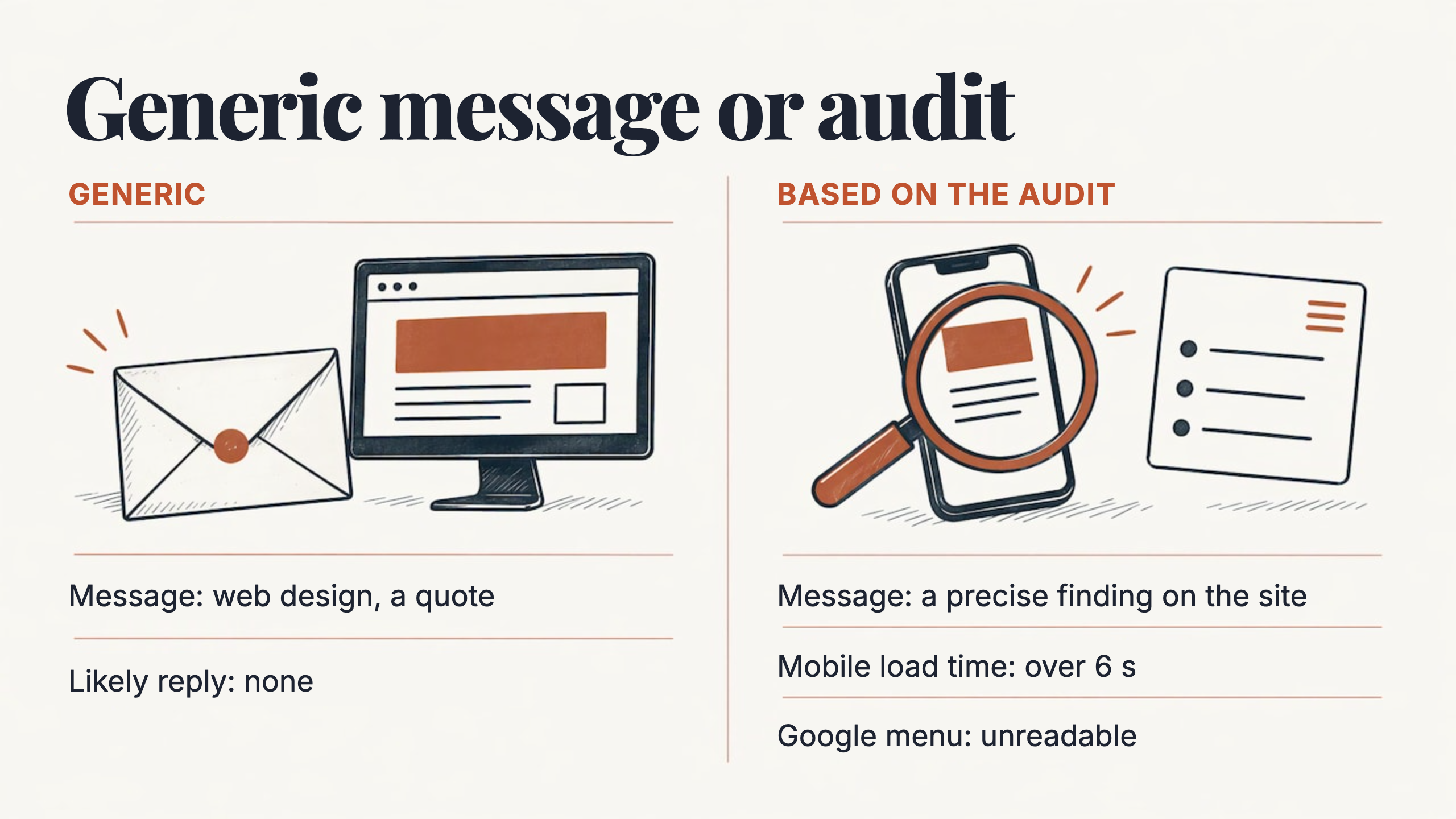
That is the point of diagnostic prospecting: you show up with a specific finding, not a vague promise. AutoLeads drafts for each business a sequence of emails and LinkedIn messages grounded in real flaws on its site. Sends go out in weekly waves from the agency's mailboxes, or sync to HubSpot or your email tool. Replies land in a built-in CRM as tasks, so a hot prospect does not get lost in a crowded inbox.
Our view
Many agencies start by looking for a tool to scrape Google Maps. In practice, they want meetings with small businesses that truly need a new site. Extraction is only the first minute of the job.
A static list ages fast: businesses close, change sites, or move. That is why AutoLeads finds companies in real time on the web and Google Maps, instead of relying on an old database or stale open data.
The real win is the diagnosis. When you email a plumber in Lyon about slow load times, Google reviews, or missing local SEO, you are not doing spray-and-pray outreach: you are sharing useful information. We built the tool so the agency arrives with that concrete diagnosis, from its own mailbox.
For agencies that live on referrals, freelance platforms, or RFPs, it is another way to fill the calendar: choose clients by trade and city, at the pace you set.
Tom
From list to calendar with AutoLeads
AutoLeads bundles in one tool what you usually stitch together by hand: local business lists by trade and city, site audit, enrichment with the owner, a verified email and phone, personalized multichannel sequences (email, LinkedIn, phone), and reply tracking in a built-in CRM.
The subscription is monthly, with credits consumed by lead volume and enrichments you enable. Three plans are on grezy.org: Starter at €249 per month, Growth at €499 per month, and Scale at €899 per month. If you do not want to make the calls yourself, the "We make the calls for you" option handles outsourced appointment setting.
If you prospect local merchants, create your AutoLeads account and run your first search by trade and city.
A simple plan for your first week
To act without scattering your effort, here is a four-step method.
- Pick one trade and one city, not ten. A single segment, such as restaurants in Bordeaux or building trades in Lyon, lets you write a precise offer.
- Define the flaw you know how to fix: slow site, no mobile version, an underworked Google profile. The audit ranks businesses against that criterion.
- Launch a first wave of a few dozen contacts and read the replies. Weekly waves let you tune the message before you scale.
- Treat every reply as a task: a yes becomes a meeting, a no becomes an exclusion, a "later" becomes a dated follow-up.
Take time to document your disclosure policy: a short text stating who you are, why you write, and how to stop messages. You will reuse it on every send, and it directly meets what the CNIL expects in prospecting.
Frequently asked questions
Sources
- Scrape Google Maps: a guide to collecting data(opens in a new tab) accessed November 17, 2026
- How to Scrape Google Maps: Local Business Data Guide 2026(opens in a new tab) accessed November 17, 2026
- Web scraping legality: issues and good practices(opens in a new tab) accessed November 17, 2026
- Scraping and B2B email prospecting: legal or not?(opens in a new tab) accessed November 17, 2026