
Phone prospecting: a method for web agencies and freelancers
Phone prospecting for web agencies and freelancers: B2B legal framework, prospect list, five-step script, objections, and follow-up to land qualified meetings.

In short
- The phone is for qualifying and booking a meeting, not for closing a website sale on the call.
- In B2B, you must tell people how you will use their number and honor opt-outs. Prior consent required since 11 August 2026 applies to consumers.
- A useful list has the right decision-maker, a reachable number, and a visible issue on the site.
- A five-step script, calm objection handling, and follow-up logged in a CRM make the difference over time.
For a web agency or freelancer, phone prospecting works when the call rests on a precise observation about the prospect's website, not a generic pitch. The goal is not to sell a site on the phone: it is to get a meeting with the owner of a small or mid-sized business who has a real need. This article lays out the full method, from the legal framework to follow-up, and shows how AutoLeads prepares each call with a site audit, the owner, a verified email, and a phone number.
What phone prospecting is for in a web agency
Phone prospecting means contacting businesses that do not know you yet, by phone, to spot a project, qualify a contact, and propose a conversation. For an agency, studio, or freelancer, the call almost always has one purpose: book a twenty- to thirty-minute meeting, by video or on site.
That framing changes everything. If you try to sell a €4,000 redesign in a three-minute call, you will get hung up on. If you aim to surface a problem and offer a diagnostic, the conversation can happen. How phone sales work and how to train teams follows the same logic: a clear goal per call, a structured conversation, repeated role play.
The phone also solves a problem many agency founders know: relying on word of mouth, freelance platforms, or RFPs. Those channels bring work, but you do not control them. A calling campaign gives you a flow you steer: you choose the trade, the city, the volume.
Realistic goals for an agency calling campaign:
- Book meetings with local small-business owners: plumbers, restaurants, practices, shops, craftspeople.
- Qualify: learn whether the site is outdated, whether the business has budget, who decides.
- Wake up contacts from a first email or a LinkedIn message that went unanswered.
- Test a segment: in twenty calls, you know whether "restaurants in Bordeaux" responds better than "building trades in Lyon".
What the law says in 2026 for B2B calls
This is the first question to settle, because the rules moved and many articles mix the two regimes. Rules changed on 11 August 2026, but for consumers. According to the CNIL, prospecting individuals now requires prior consent, while professionals can opt out of prospecting. In both cases, you must provide information.
For an agency calling businesses, keep three points in mind:
- Inform: the person must know you are using their number, and why. The simplest approach is to say it at the start of the call and mention it in your legal notices.
- Honor opt-outs: if an owner asks not to be called again, you log it and do not call back. The CNIL states that opting out must be simple and free.
- Stay relevant: the call must relate to the person's professional activity. Offering a website to a restaurateur for their restaurant is coherent. Calling about something unrelated to their trade is not.
The CNIL indicates time slots of 10 a.m. to 1 p.m. and 2 p.m. to 8 p.m., Monday to Friday, for calls to consumers who gave consent. Those are not the B2B prospecting rule. In practice, still call when an owner is likely to answer: see below.
If your calls also reach individuals, for example a tradesperson using a personal mobile, check the applicable regime on the CNIL page. On the Bloctel side, the FAQ for professionals states that the service winds down from 11 August 2026, in favor of proof of explicit consumer consent. Again, that targets consumer prospecting.
Build a prospect list you can actually use
A bad list ruins the best script. The three classic flaws: switchboard numbers with no path to the owner, stale data, and no angle. You are then calling "cold" in the strong sense, knowing nothing.
A prospect list a web agency can use has five elements per company:
| Element | Why it matters |
|---|---|
| Name of the owner or decision-maker | You ask for a person, not "the manager". |
| Direct line or professional mobile | Avoids the switchboard and gatekeeping. |
| Verified email | Enables a message before or after the call. |
| Observation about the site | Slow site, outdated design, low Google visibility: that is your hook. |
| Local context | Google reviews, activity, city: they make the call credible. |
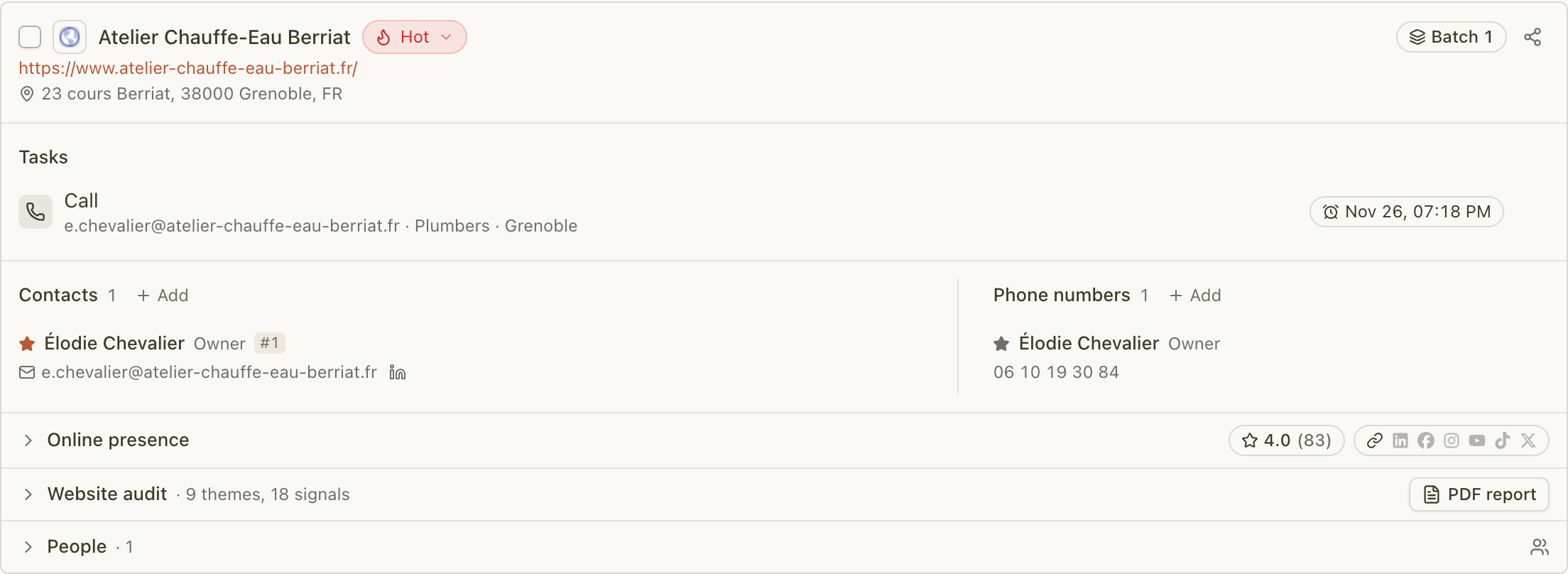
Pulling this together by hand takes hours per prospect: open Google Maps, visit the site, find the owner, find an email, verify a number. That is where AutoLeads saves time. You pick a sector and a city, for example "plumbers in Lyon". The tool finds those businesses in real time on the web and Google Maps, audits their online presence (outdated or slow site, weak SEO, Google reviews, social), then enriches each lead with the owner, a verified email, and a phone. You are not calling from a frozen database: the list reflects what exists today.
Then sort by priority. Call first the businesses where the need is most visible: site not mobile-friendly, very slow, no worked Google review profile. Those are the ones where your call makes the most sense.
Prepare the call before you pick up
Before a calling session, prepare three things per prospect in under two minutes:
- A concrete observation: "your site takes several seconds to load on mobile", "your Google reviews get no replies", "your homepage has no obvious contact path".
- An opening question you can ask without reading it.
- A specific meeting offer: "I can walk you through the audit in twenty minutes on Thursday or Friday?"
AutoLeads already provides these: for each company, it drafts email and LinkedIn sequences based on real flaws on the site. You reach the phone with the same diagnosis as in the message you sent, which keeps channels aligned.
A few field rules:
- Pick your time slots. Retail and restaurant owners are rarely reachable during service. A tradesperson often answers early morning or late day. Test two windows and compare reach rates.
- Work in blocks. One hour of calls in one trade beats ten scattered calls: you refine your pitch with each conversation.
- Prepare physically. Stand or sit upright, water nearby, no parallel tasks. It shows in your voice.
A five-step script, without reading aloud
A script is not text to recite: it is a frame. A simple five-step structure is widely used in prospecting: hook, quick qualification, value, objections, booking. Here is how to apply it in a web agency.
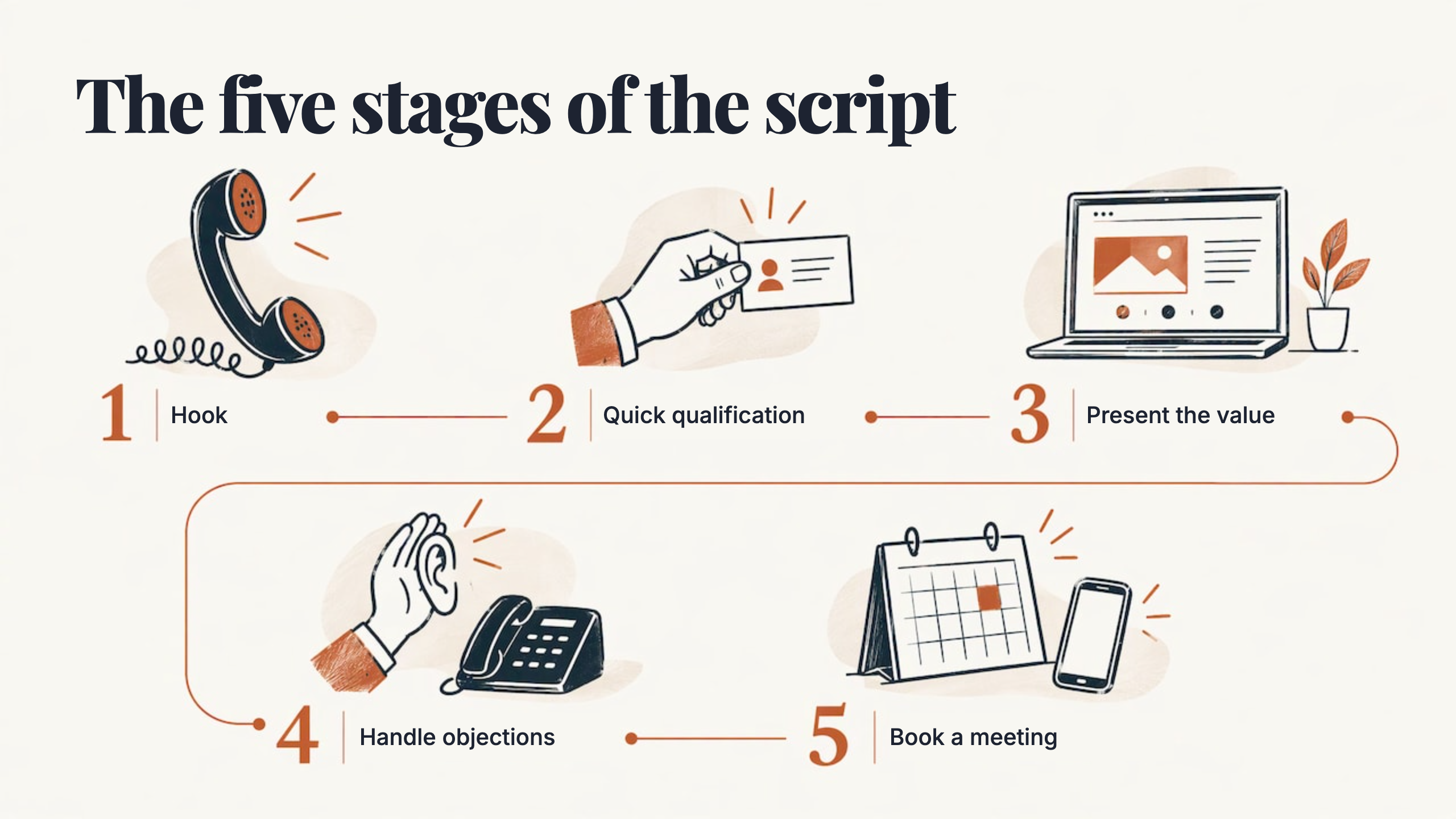
1. The hook (15 seconds)
Say who you are, why you are calling, and why this person. Skip "do you have two minutes?", which invites a no. Example:
"Hello Ms. Martin, Julien from Pixel Lyon agency. I'm calling because I looked at your company site on my phone: the quote page takes a while to open. I wanted to mention it briefly."
A checkable observation builds immediate credibility. It shows the call is not spray and pray.
2. Qualification (30 to 60 seconds)
Two or three open questions are enough: "Do clients find you mostly via Google or referrals?", "When was the site last redone?", "Are you the one who decides on these topics?". You learn whether the person decides, whether the site matters for the business, and whether a project exists.
3. Value
One sentence, centered on their outcome: "On sites like this, we usually fix speed and the contact page so visitors call you more easily. I have an audit of your site I can walk you through." Avoid jargon: talk about clients, calls, quote requests, not Core Web Vitals.
4. Objections
See the next section: that is where most calls are won or lost.
5. Booking the meeting
Offer two slots, never "whenever suits you". Confirm by email right away, with the diagnostic attached or linked. Restate the benefit: "You'll see how the site is costing you inquiries."
Handle objections without reciting a playbook
An objection is rarely a final no: it is a request for reassurance, or a polite way to end the call. The technique comes down to four moves: listen to the end, paraphrase, ask a question, propose a small next step.
Objections web agencies hear most often:
| Objection | What it often means | Typical response |
|---|---|---|
| "I'm not interested" | No context, fear of a hard sell | "I understand. I'm not selling anything today: I only want to show you what I saw on your site. Do you have five minutes on Thursday?" |
| "We already have someone" | A vendor exists, not necessarily a happy one | "Great. Are you happy with site speed and the leads it brings?" |
| "Send me an email" | A way to close the call | "Happy to. I'll send your site audit: which address should I use? I'll call you Thursday to discuss it." |
| "No budget" | No perceived value | "I understand. The meeting is exactly to see whether this is worth budgeting for." |
| "I don't have time" | Bad timing | "No problem. What time this week works for you, morning or end of day?" |
The golden rule: ask more questions than you make statements. Listening also means noting the prospect's words to reuse in the meeting. If someone clearly does not want further calls, thank them, hang up, and record the opt-out: that is mandatory, not optional.
Track calls and measure results
A calling campaign without follow-up fades. In your CRM, right after each call, log the result and next action: meeting booked, callback requested, number to fix, refusal or opt-out. Every follow-up needs a date. A refusal should block new outreach on any channel.
Metrics to track, by segment and over the campaign:
- Calls placed: raw volume.
- Reach rate: share of calls where you speak to someone.
- Useful conversations: those where a need or decision-maker is identified.
- Meetings booked: the central metric.
- Opportunities created and signed deals: what matters for revenue.
Calculate these ratios by trade and city. You will quickly see whether "hair salons in Nantes" books more meetings than "garages in Toulouse", and you can reallocate time.
In AutoLeads, replies land in a built-in CRM as tasks, and sends go out in weekly waves from your mailboxes, or sync to Lemlist or HubSpot. A follow-up call then lines up naturally with the reply to an email.
Combine phone, email, and LinkedIn
Phone alone is demanding: many calls hit voicemail. Agencies that book the most meetings chain channels: an email with the observation, a LinkedIn message to the owner, then a call that references both. The prospect has already seen your name; the call is not a surprise.
A simple two-week sequence:
- Day 1: email with the main site observation.
- Day 3: LinkedIn message to the owner, one sentence on the same observation.
- Day 5: call, referencing the email sent.
- Day 8: follow-up email with a second flaw spotted.
- Day 12: last call or closing message.
That is what AutoLeads generates: a personalized multichannel sequence based on flaws detected on each company's site.
How AutoLeads prepares your calls
AutoLeads is prospecting software built for French web agencies. You choose a sector and a city; the tool finds businesses in real time, audits their site, reviews, and social presence, finds the owner, a verified email, and a phone number, then writes email and LinkedIn sequences grounded in real site flaws. You call with a diagnosis in hand.
Subscriptions are monthly, with credits consumed by lead volume and enrichments you turn on: Starter at €249, Growth at €499, and Scale at €899 per month. If you prefer not to make the calls yourself, the "We make the calls for you" option handles outsourced meeting booking.
Our view
Many web agencies live on word of mouth, and while it works, nobody complains. The day two clients leave, you realize you have no channel you can activate.
The phone feels scary because we imagine aggressive selling. In reality, it is the most honest conversation when you have something specific to say: "I looked at your site, here is what is costing you customers". The whole challenge is showing up with that observation, not a generic line the owner has heard ten times this week.
That is why we built AutoLeads around the audit. It detects in real time businesses whose need is visible, without a frozen database, enriches each lead, and prepares messages based on real flaws on their site. The agency spends time talking to owners who genuinely need a new site, not hunting for numbers.
Our belief: an agency that controls its prospecting chooses its clients, its rates, and its pace.
Tom
Frequently asked questions
Sources
- CNIL: Commercial prospecting by phone (outside call automata), what are the rules?(opens in a new tab) accessed November 17, 2026
- Bloctel: FAQ for businesses(opens in a new tab) accessed November 17, 2026