Prospecting on LinkedIn: A Method for Web Agencies
Prospect on LinkedIn as an agency or freelancer: profile, targeting, messages, follow-ups, email, and CNIL compliance, with a clear step-by-step method.

In short
- A prospecting profile answers one question: "Why should I talk to you?" Your headline, banner, and About section exist to answer it.
- A connection request is one sentence, sells nothing, and rests on a specific fact about the person or their company.
- For an agency, the best fact is a visible flaw: a slow or outdated site, no paid ads, or few Google reviews.
- LinkedIn and email work better together, in a short sequence with spacing between touches.
- In B2B, email prospecting is regulated by the CNIL (France's data protection authority): tie to the recipient's trade, clear information, simple opt-out.
For a web agency, studio, or freelancer, prospecting on LinkedIn works when three things line up: a profile that gives people a reason to reply, a tight target, and a first message backed by a verifiable fact about the company. The last point costs the most time by hand. That is where AutoLeads, our prospecting tool, changes the game: it finds local small businesses in a given trade and city, surfaces real gaps in their online presence, and drafts a LinkedIn and email sequence for each one starting from that diagnosis.
Why LinkedIn fits agencies, and where it eats time
Your typical clients are small business owners: a tradesperson, a restaurant owner, a professional office, a downtown shop. They are rarely very active on LinkedIn, but their company page is often there, and the owner is identifiable. LinkedIn is mainly for reaching the right person, not waiting for them to find you.
The real bottleneck is not sending invitations. It is preparation: knowing who to target, opening their site, reading reviews, spotting what is wrong, finding the owner's name, then writing a message that proves you did the work. For one company, easily fifteen minutes. For fifty, a week of unpaid work.
That is exactly the work we wanted to take off agencies' hands without sacrificing personalization.
Step 1: Prepare your profile before the first message
Before you even write, the person you contact opens your profile. In a few seconds it must answer: why is this agency messaging me? A prospecting profile is not a CV; it is a low-key sales page.
Four elements do the job:
- Headline: State the target and outcome, for example "Websites for local trades and shops: more calls, more quotes", not "Agency Director".
- Banner: Proof, such as a number, a before/after site, or logos of local clients you may show.
- About: The target, the problem you solve, your method, and a simple way to reach you.
- Recommendations: A few real client endorsements beat any tagline.
If you rely on word of mouth today, this step ties to a related topic: how to get recommended more often when you work independently. A clear profile and visible recommendations are the digital version of that reputation.
Step 2: Define your target and find relevant prospects
The question that comes up most: how do you find prospects on LinkedIn without drowning in profiles that will never sign? The answer is one rule: the narrower the target, the sharper the message.
For an agency, a workable target combines four criteria:
- A trade: plumbers, restaurants, physiotherapists, garages, hair salons.
- An area: a city or metro. Your messages can mention the neighborhood or local competition.
- A visible need: no site or an old one, not mobile-friendly, weak SEO, no Google Ads, few reviews.
- A decision-maker: the owner or manager, not a switchboard.
Criteria 1, 2, and 4 are found with LinkedIn search filters. Criterion 3 does not appear on LinkedIn: you have to check the company site, Google listing, and social accounts. Yet it is what separates a message that sounds like everyone else's from one that starts a conversation.
AutoLeads starts there. You pick a trade and city, for example "plumbers in Lyon" or "restaurants in Bordeaux". The tool finds those businesses in real time on the web and Google Maps, then audits online presence: outdated or slow site, weak SEO, no ads, Google reviews, social profiles. It enriches each record with contacts found: owner, email, phone, LinkedIn. You do not open a hundred tabs: you get a list already ranked by visible need.
Step 3: The connection request
A connection request has one goal: get accepted. It sells nothing. One sentence is enough, explaining why you are writing to this person with a verifiable fact: something they published, opening a second location, their sector in your city.
Three simple rules:
- no offer, no link, no meeting request;
- a specific fact rather than a generic compliment;
- a peer tone, no stiff formalities or canned lines.
Example for a restaurant owner: "Hi Camille, I work with Bordeaux restaurants on online visibility. I saw you opened your second location in Les Chartrons, congratulations."
One practical constraint: a free account limits how many connection requests can include a personalized note, and the exact limit varies between LinkedIn's help pages. If volume is high, check your account quota before building your plan. Either way, a short precise note beats a long one sent to everyone.
Step 4: The first message after acceptance
The connection is accepted. The classic trap is sending a pitch with a booking link right away. This first message should get a reply, not book a meeting.
The structure that works:
- a sincere, specific remark;
- an open question tied to their business;
- nothing else: no brochure, no calendar.
For an agency, the most natural remark comes from the audit. Example: "I looked at your site on my phone: the reservation page takes several seconds to load. Does online booking account for a large share of your covers?"
You give something concrete, show you looked, and the question invites a one-line answer. That is the diagnostic approach: arrive with an observation, not a promise.
Signals that justify reaching out
Some events make your message legitimate: a job change, a new location, a recent post on a topic close to yours, a visit to your profile. For a very small local business, add trade-specific signals: a site redesign from years ago, an insecure site, recent Google reviews with no owner response.

Step 5: Follow up without nagging
Most replies come after the first touch, not during it. A simple sequence over about a month keeps you from burning out:
| Day | Action | Content |
|---|---|---|
| D+0 | Connection request | One sentence, one fact, no pitch |
| D+3 to D+5 | First message (if accepted) | Remark + open question |
| D+10 | Quantified finding from the audit | |
| D+18 | Follow-up | Something new, not "just following up" |
| D+28 | Last message | Short, polite, door left open |
Each follow-up adds new information: an example from a peer in the same city, a second flaw found, a concrete idea. Without something new, a follow-up is only a reminder, and it annoys.
This cadence is a guide, not a law. Adjust from the replies you get, and keep one call to action per message.
Step 6: Pair LinkedIn and email
Email and LinkedIn prospecting are not opposites. A small business owner checks email more often than LinkedIn. Your sequence gains from both: LinkedIn for first contact and credibility, email to develop the observation with more room.
The hard part is keeping the same thread on both channels without copying word for word. AutoLeads drafts for each company an email and LinkedIn sequence built on the real gaps found. Sends go in weekly waves from the agency's mailboxes and accounts, or push to Lemlist, HubSpot, or CSV export. Replies land in an integrated CRM as tasks: you know whom to answer first.
The legal framework: what the CNIL says about B2B prospecting
Something agencies forget: email prospecting is regulated, even in B2B. According to the CNIL page on prospecting by email, B2B prospecting may rely on legitimate interest when the outreach relates to the prospect's profession. They must be informed and able to opt out simply and at no cost. Generic addresses like info@ or contact@ are not subject to these rules.
For your messages, that gives a clear rule of conduct:
- your offer must relate to the recipient's activity: offering a website to a plumber is coherent;
- every message identifies your agency;
- every message allows refusing further messages by a simple means;
- you honor an objection immediately.
As a precaution, apply the same habits to private LinkedIn messages: clear identity, ability to say "no thanks" in one line. For a precise question about your situation, speak to a lawyer or your organization's data protection officer.
Step 7: Measure, then adjust
Three numbers are enough to run a campaign:
- connection request acceptance rate;
- message reply rate;
- meetings booked.
Do not copy success rates from articles. Measure yours on your first 50 invitations, then change one variable at a time: the opening line, the trade targeted, the send day. Low acceptance points to profile or opener; low replies to the first message; few meetings to the final offer.
An example: you contact 50 plumbers in Lyon and get few acceptances. Before changing target, reread your profile headline: does it speak to tradespeople? Then test an opener that cites a local fact rather than a general line.
Our view
An agency almost never lacks skill: it lacks time to prospect. When you prospect by hand, you end up sending the same message to everyone because you still need to move forward.
We built AutoLeads on a simple idea: the most effective message shows an owner what you actually saw on their business. A slow site, a Google listing with unanswered reviews, no ads: those are facts, not sales lines.
That is why the tool audits each company, finds contacts, and drafts the sequence from those gaps. The agency arrives with a concrete diagnosis, not a stale database or a generic message. It is also a way to rely less on word of mouth, freelance platforms, or RFPs.
Your energy goes where it counts: answering interested owners and running meetings.
Tom
AutoLeads: From profile to booked meeting
If you want to apply this method without spending your evenings on it, AutoLeads offers three monthly plans: Starter at €249 per month, Growth at €499 per month, and Scale at €899 per month. The subscription runs on credits consumed by lead volume and enrichments you enable. An option, "We call for you", extends prospecting by phone.
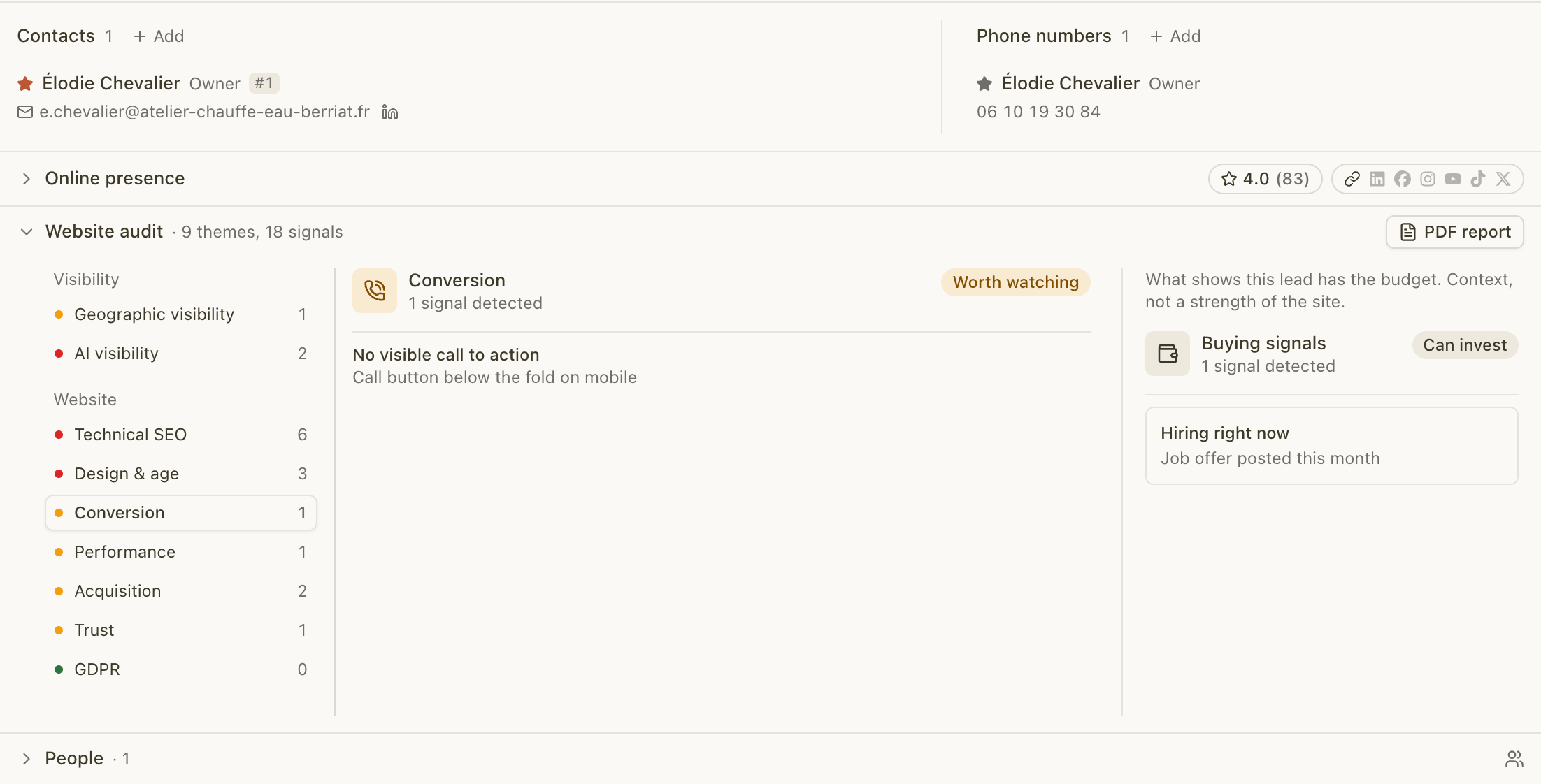
You choose a trade and city, the tool prepares leads, audits, and sequences, and you track replies in the integrated CRM.
Frequently asked questions
Sources
- Commercial prospecting by email, SMS, MMS and automated calling, CNIL(opens in a new tab) accessed November 24, 2026