
Prospecting Funnel: Stages, Ratios, and Leaks for an Agency
Build your agency prospecting funnel: 7 steps, ratios to track, GDPR rules for your B2B company database, and levers to fill the top.

In short
- The prospecting funnel covers the upstream phase: target, contact, qualify. The sales funnel takes over once a prospect becomes an opportunity.
- Seven stages are enough for an agency: targeted, audited, contacted, in conversation, meeting held, proposal sent, signed.
- Calculate your pass-through rate at each stage and note a reason for every loss: your own numbers matter more than any benchmark.
- The quality of the company list at the top matters more than volume. In B2B, email falls under opt-out rules, as long as the message relates to the recipient's business activity.
A prospecting funnel describes the path of a local business from the moment you identify it until it becomes a qualified meeting, then a client. For a web, SEO, or ads agency, you win or lose at the top: if you pour in contacts with no visible need, no follow-up will save the rest. With AutoLeads, you choose a trade and a city, the tool finds businesses, audits their online presence, and drafts messages grounded in the gaps it finds: your funnel starts with prospects who have a reason to reply.
Prospecting funnel vs. sales funnel: where is the line?
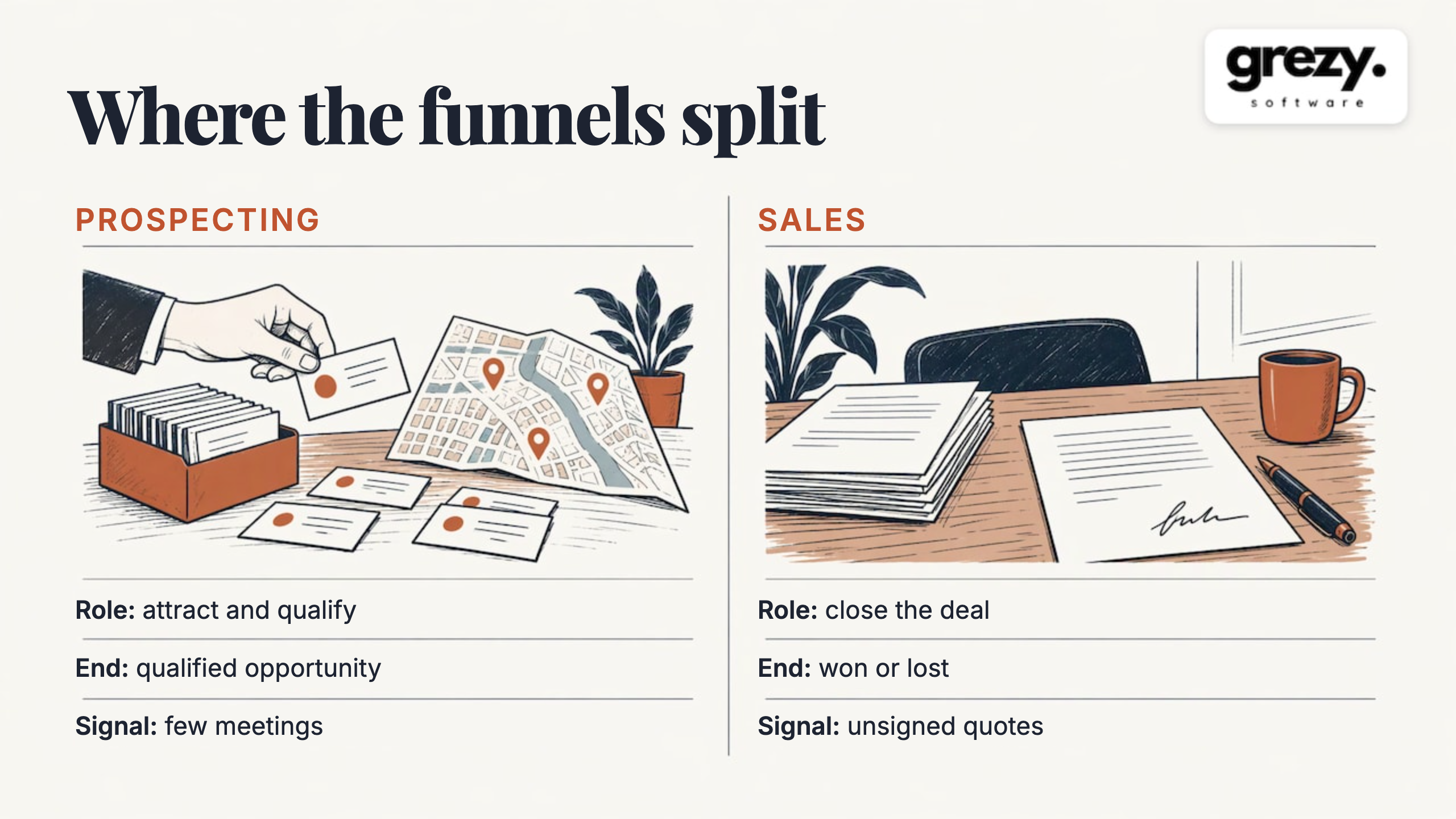
The two terms overlap, but they are not the same half of the job. The prospecting funnel is the upstream part: attract, capture, sort, and qualify contacts. It ends when the prospect is qualified enough to be handled as an opportunity. The sales funnel starts there and ends with a deal won or lost.
For a freelancer or agency founder, the line is blurry, because the same person often prospects and sells. It is still useful: it tells you which metric to improve. If meetings are rare, the problem sits in prospecting. If meetings are plentiful but quotes do not sign, the problem sits in sales.
The B2B cycle is also longer than B2C, sometimes with several stakeholders. For a very small local business, the decision-maker is usually the owner, which shortens the path. That is a real advantage with “local shops and trades” targets: the right contact is identifiable, and the need is visible from the outside.
Seven stages of a funnel for an agency
The French government offers a seven-step prospecting plan for small businesses: objectives, market analysis, offer, targeting, methods, buying journey, and follow-up. That is the thinking framework. To run day to day, you need a more operational funnel where each stage has a verifiable entry criterion. Digital Study proposes seven, adapted here for an agency.
| Stage | Entry criterion | Where it leaks most often |
|---|---|---|
| 1. Targeted | Business in a chosen trade and city, with a visible need | Target too broad, stale list |
| 2. Audited | Gaps noted: site, SEO, advertising, reviews | Generic audit, no specific fact |
| 3. Contacted | First message sent to the right decision-maker | Wrong contact, email does not arrive |
| 4. In conversation | A reply, even a negative one | Message talks about you, not them |
| 5. Meeting held | Conversation completed | Follow-up too late |
| 6. Proposal sent | Quote or action plan sent | Offer misaligned with budget |
| 7. Signed | Agreement obtained | Follow-up stops |
Stage 1: target one trade in one city
Precision pays here. “Restaurants in Bordeaux” is a segment: you can speak to it, tailor your offer, and measure results. “All SMBs” is not. The France Num guide also recommends quantifying goals by estimating how many clients to contact per week, month, or quarter.
If you are unsure which trades to prioritize, a deeper look at strategic direction for a small business helps you decide which activity to serve first before you build the list.
In AutoLeads, this stage means entering a trade and a city. The tool finds businesses in real time on the web and Google Maps, so you avoid starting from a purchased list whose freshness is never guaranteed.
Stage 2: audit before you write
This is the stage most agencies skip for lack of time. Opening a hundred sites to note dated design, a slow page, no advertising, or neglected Google reviews takes hours. Without that audit, your message looks like everyone else's outreach.
AutoLeads audits each business's site (outdated or slow), SEO, advertising, Google reviews, and social profiles. You show up with a concrete diagnosis instead of a generic pitch: the difference between an ignored email and one that gets a reply.
Stage 3: reach the right decision-maker
In its B2B practical guide, Adie recommends building a list with detailed contact details for each stakeholder, finding the right decision-maker, and choosing how to reach them: phone, mail, email, or LinkedIn. Each AutoLeads lead is enriched with the owner, email, phone, and LinkedIn profile when found, which avoids manual contact-by-contact research.
Sends go out in weekly waves from the agency's mailboxes and LinkedIn accounts. You can also push to HubSpot or export as CSV. A steady cadence beats one big blast: it gives you time to handle replies.
Stage 4: get the conversation
The message makes the difference. For each business, AutoLeads drafts a sequence of emails and LinkedIn messages built on the gaps found in stage 2. A line like “your Google listing has few recent reviews and your site takes several seconds to load on mobile” shows you looked. You keep control to review and adjust tone before sending.
Replies land in a built-in CRM as tasks: each reply becomes an action to handle, so no prospect is left hanging because it was missed.
Stages 5 to 7: from meeting to signature
From the meeting onward, you are in the sales funnel. Digital Study qualifies the opportunity with BANT: budget, authority, need, timeline. A proposal sent without those four elements confirmed is a proposal that stalls. The upstream audit feeds the discussion: you are not discovering need in the meeting, you are confirming it.
If you prefer to focus on selling, the platform's “We call for you” option offers outsourced meeting booking. Its price is not published.
Measuring the funnel: pass-through rates and reasons for loss
A funnel you do not measure stays a diagram. Two rules are enough.
Pass-through rate. Divide the number of prospects who reached the next stage by the number at the current stage, multiplied by 100. Digital Study's example: 30 meetings held from 96 conversations, or 31%. Count everyone who reached the stage, not only those who moved on.
Reason for loss. Every prospect who exits gets a reason: no need, already equipped, price, no reply. After a quarter, you see whether you are losing on target, message, or offer. The same guide advises small businesses to tally by quarter and track time between stages.
A sample set of figures, for illustration
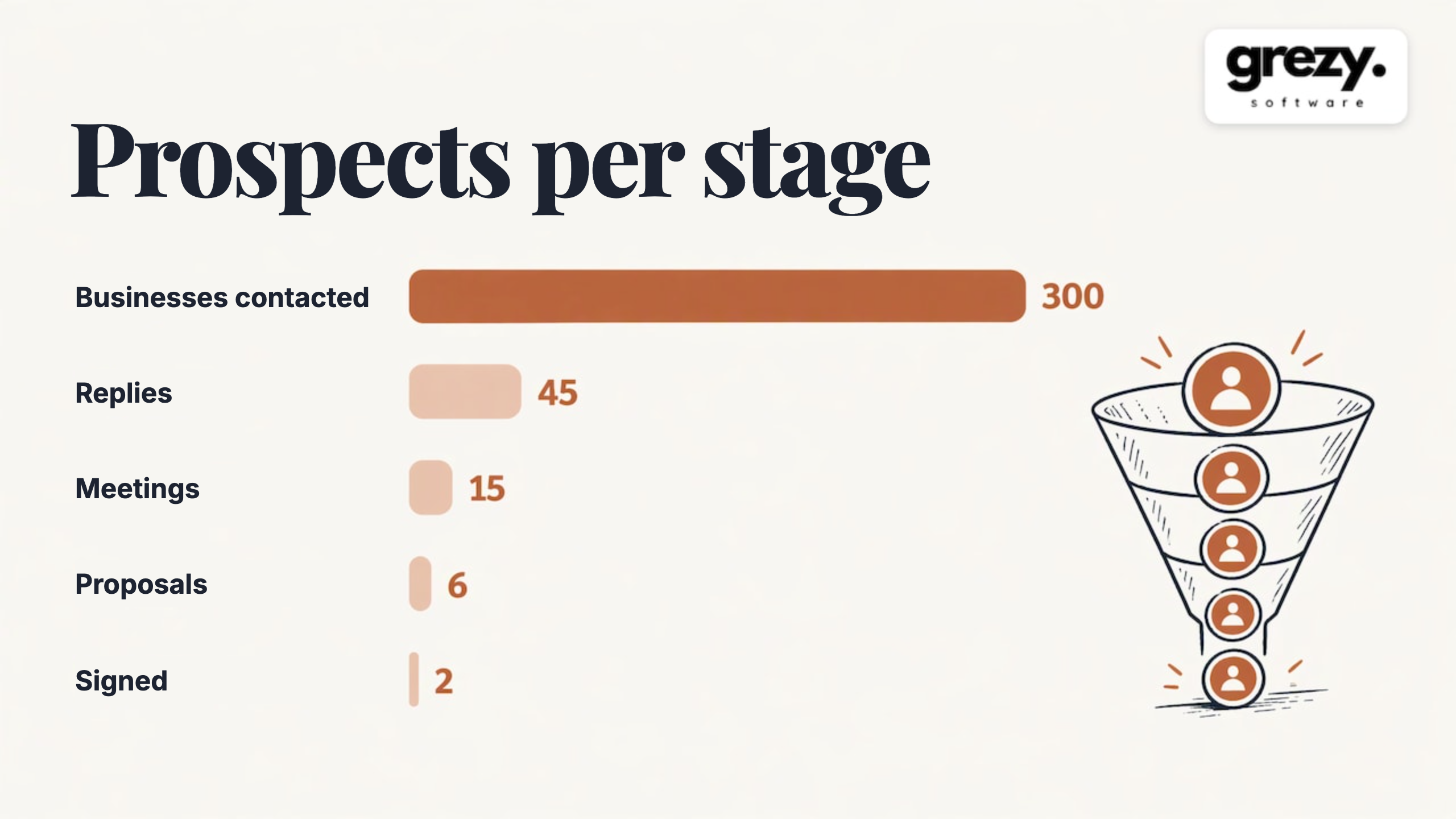
Imagine an agency that contacts 300 businesses per quarter: 45 reply, 15 lead to a meeting, 6 receive a proposal, 2 sign. Pass-through rates are 15%, 33%, 40%, and 33%. The heaviest leak is between contact and reply. The agency revisits message and targeting before touching the commercial offer. These figures are fictional: they illustrate the method, not a target.
What benchmarks to use
For cold email, ReCom cites a French average of about 11% open rate and 1.1% click rate, per the Baromètre Nomination 2024. The same article ranks deliverability among five KPIs to watch and describes it as an infrastructure problem when it drops below 95%.
Still, treat averages with caution. IOquery reminds readers that no universal figure exists: average order value, sales cycle, and competition change everything, and lead quality at the top matters more than the rest. Compare your numbers quarter to quarter, not to another sector. Look at volume as much as rate: a low-rate, high-volume campaign can produce more meetings than an overly narrow one.
The company database: quality first, rules second
Searches around B2B company databases come down to two worries: where to find contacts, and what you may do with them. On the first, a purchased list ages fast and serves everyone at once. A list built on demand, by trade and city, stays current and preserves your angle. That is the AutoLeads principle: businesses are found in real time, not pulled from a frozen database.
On the second, French law is precise. Rules vary by channel.
Email and LinkedIn in B2B
France Num notes that for email, SMS, and messaging, B2B follows opt-out based on legitimate interest, while B2C prospecting requires opt-in. In practice, you may write to an owner at a professional address if your pitch relates to their activity, tell them where their data came from, and let them object easily. A message about a restaurant's online visibility, sent to its manager, fits this framework.
Phone
The CNIL (France's data protection authority) states that in B2B, a call may rely on legitimate interest when its subject relates to the profession of the person contacted. Prior consent has applied to consumer canvassing since 11 August 2026, which does not cover calling an owner on a professional topic. Calling hours remain Monday to Friday, 10 a.m. to 1 p.m. and 2 p.m. to 8 p.m.
Retention and objection
The CNIL reference framework on managing commercial activities sets retention for a prospect who is not a customer at three years from collection or last contact from them. A documentation request or a click counts as contact, not merely opening an email. Someone who objects must be excluded from later campaigns: keep them on an exclusion list. For guidance on your case, contact the CNIL or a lawyer specializing in personal data.
Five common leaks and how to plug them
- Target too broad. Narrow to one trade and one city, measure, then expand.
- Message with no specific fact. Ground every first touch on something observed: slow site, no advertising, few reviews.
- Sending in one burst. Weekly waves leave time to reply and protect your mailbox reputation.
- Lost replies. Turn every reply into a task with a due date.
- No reason for loss recorded. Without a reason, you repeat the same mistakes next quarter.
Filling the top of the funnel with AutoLeads
AutoLeads bundles stages 1 to 4 in one tool: trade and city selection, audit, contact enrichment, personalized sequences, wave-based sending, and a built-in CRM. Plans are billed monthly: Starter at €249, Growth at €499, and Scale at €899, with credits consumed according to lead volume and enrichments enabled. The “We call for you” option extends the funnel through to the meeting. See everything on the AutoLeads plans page.

For an agency that lives on word of mouth, the challenge is to make prospecting steady. A funnel that receives newly audited prospects every week gives you numbers to analyze and a path to steer.
Our view
The agencies that come to us almost all share the same reflex: they improve the bottom of their funnel, the quote, the deck, the follow-up, while the leak is at the top. A generic message sent to a stale list cannot produce conversations, however good the offer.
Our belief is simple: a prospect replies when you talk about their problem. An outdated site, unanswered Google reviews, no advertising while competitors run ads: these are facts an owner recognizes instantly. That is why AutoLeads audits each business before drafting a single message.
We also want follow-up to stay readable. Replies arrive as tasks in a built-in CRM, sends go out from your own mailboxes in waves, and you keep control of what goes out in your name. Your calendar fills with meetings with local small businesses that have a visible need, without relying on word of mouth or tenders alone.
Alexis
Frequently asked questions
Sources
- France Num: commercial prospecting, steps in a plan(opens in a new tab) accessed November 23, 2026
- France Num: commercial prospecting and GDPR(opens in a new tab) accessed November 23, 2026
- CNIL: commercial prospecting by phone(opens in a new tab) accessed November 23, 2026
- CNIL: reference framework on managing commercial activities(opens in a new tab) accessed November 23, 2026
- Adie: prospecting B2B clients(opens in a new tab) accessed November 23, 2026
- Digital Study: prospecting funnel(opens in a new tab) accessed November 23, 2026
- ReCom: B2B email marketing(opens in a new tab) accessed November 23, 2026
- IOquery: lead-to-customer conversion rate(opens in a new tab) accessed November 23, 2026