
ICP: Definition and Method for a Web or Digital Agency
ICP in plain terms, how it differs from a persona, and a step-by-step method so web, SEO, or Ads agencies can define their ideal client and prospect more effectively.

In short
- The ICP describes the ideal company (sector, size, location, digital maturity, budget); the persona describes the person you talk to inside that company.
- For an agency, useful criteria include trade, city, size, site condition, local visibility, Google reviews, and lack of paid advertising.
- The best ICP is built from your current most profitable clients, not from gut feel.
- An ICP helps you filter lists, personalize messaging, and decide who not to contact; revise it at least once a year.
An ICP (Ideal Customer Profile) is the description of the company that gets the most value from your offer and returns the most to you. It describes a type of business, not a person: sector, size, geographic area, online situation, likely budget. For a web, SEO, or Ads agency, a well-defined ICP changes prospecting: instead of emailing “every small business in France”, you know which trades, in which cities, with which visible flaw deserve your first message. Tools such as AutoLeads, our prospecting tool, start from a trade and a city to find these companies; you still need to know which ones to pick. That is what this article is about.
ICP: a simple definition
ICP means Ideal Customer Profile. Gartner describes it as the set of firmographic, environmental, and behavioral attributes of the accounts that should become your most profitable customers. In agency language: it is the profile of the client for whom your work delivers the best results, with the least sales friction, and who stays a long time.
Three words matter in this definition.
- Firmographic: characteristics of a company (sector, headcount, revenue, location), like demographics for an individual.
- Behavioral: what the company does or does not do, for example publishing articles, investing in advertising, responding to reviews.
- Profitable: the ICP is not the easiest client to sign. It is the one who pays well, stays, refers others, and does not burn you out.
Note that “ICP” also has unrelated meanings in other fields. Here, it refers only to the ideal customer profile in B2B marketing and sales.
ICP, target customer, persona: do not conflate them
The three concepts overlap, but they answer different questions.
| Concept | Describes | Question it answers | Example for a web agency |
|---|---|---|---|
| ICP | A company | Which businesses to target? | Plumbers with 3 to 10 staff in Lyon, site over 5 years old and not mobile-friendly |
| Persona | A person in the company | Who to talk to, with which words? | The owner-founder, who decides alone, lacks time, and judges on inbound calls |
| Market segment | A large group of possible clients | Where is the market? | Building trades |
The ICP filters to the right door; the persona helps you speak to the right person behind it. This image comes from Personæ, which recommends layering the two in a matrix: for each ICP segment, map the buyer, end user, technical evaluator, and champion (the person who advocates for your offer internally). In your case, the matrix is often simple: with a very small business, buyer and user are often the same person, the owner.
A B2B persona example for an agency
Take the ICP “independent restaurants, 5 to 20 covers, in downtown Bordeaux.” The related persona might read in a few lines:
- Role: owner-manager, often on the floor or in the kitchen.
- Priority: fill evening and weekend services.
- Frustration: a site that does not show an up-to-date menu, Google reviews with no replies.
- Preferred channel: email in the morning before service, phone early afternoon.
- Argument that lands: a concrete, quantified flaw, with a proposed fix.
Here, the persona is a working hypothesis to confirm by talking to real managers. The ICP, by contrast, is validated in your numbers.
Why an agency needs an ICP
Many agencies live on word of mouth, freelance platforms, or RFPs. Those sources have one thing in common: you do not choose your clients. An ICP flips the logic, with three very concrete benefits.
- Cleaner lists. You search for companies by precise criteria rather than by volume. Every contact removed before send is time saved and sender reputation preserved.
- More relevant messages. Writing to “a plumber in Lyon with no mobile site” lets you open on a verifiable fact. A generic message looks like all the others.
- A shorter sales cycle. When the need is visible, you do not have to convince anyone it exists.
The ICP also helps you say no. A client outside the profile (budget too low, ten-person buying committee, need far from your expertise) costs management time, revisions, and sometimes a quick exit.
ICP criteria for a web, SEO, or Ads agency
ICP models built for software vendors talk about tech stack or funding rounds. Your target is local small businesses, so the relevant criteria differ.
Firmographic criteria
- Trade: plumber, restaurateur, dentist, estate agent, hairdresser. Pick one or two to start, not ten.
- Geographic area: one city or metro area, especially if you do local SEO or proximity campaigns.
- Size: headcount and age. A company with 3 to 20 employees usually has a reachable owner and a real marketing budget.
- Activity code: in France, each company has a NAF code (also called APE), the French activity classification from INSEE (national statistics institute). It targets a sector reliably, better than a single keyword.
Behavioral criteria and visible need
This is where an agency ICP stands out. Your offer addresses flaws anyone can see from the outside:
- old, slow, or non-mobile site;
- weak ranking on “trade + city” queries;
- incomplete Google Business Profile, few reviews, or reviews without replies;
- no advertising while local competitors run ads;
- inactive social accounts.
A lead with two or three of these signals has a clearer need than one with none.
Profitability criteria
- Plausible budget: a business with enough margin to fund a site, SEO retainer, or monthly ad spend.
- Value of a customer to them: a tradesperson whose jobs bring in thousands of euros quickly grasps why a site that generates leads matters. A very low basket-size retail business, less so.
- Relationship length: trades that renew needs (SEO, ads, maintenance) are worth more to a recurring agency than one-off site buyers.
Exclusion criteria
Note what disqualifies too: franchises whose site is run by headquarters, companies whose comms are already with an agency, sectors where you have no references. A short exclusion list beats a long wish list.
How to define your ICP in five steps
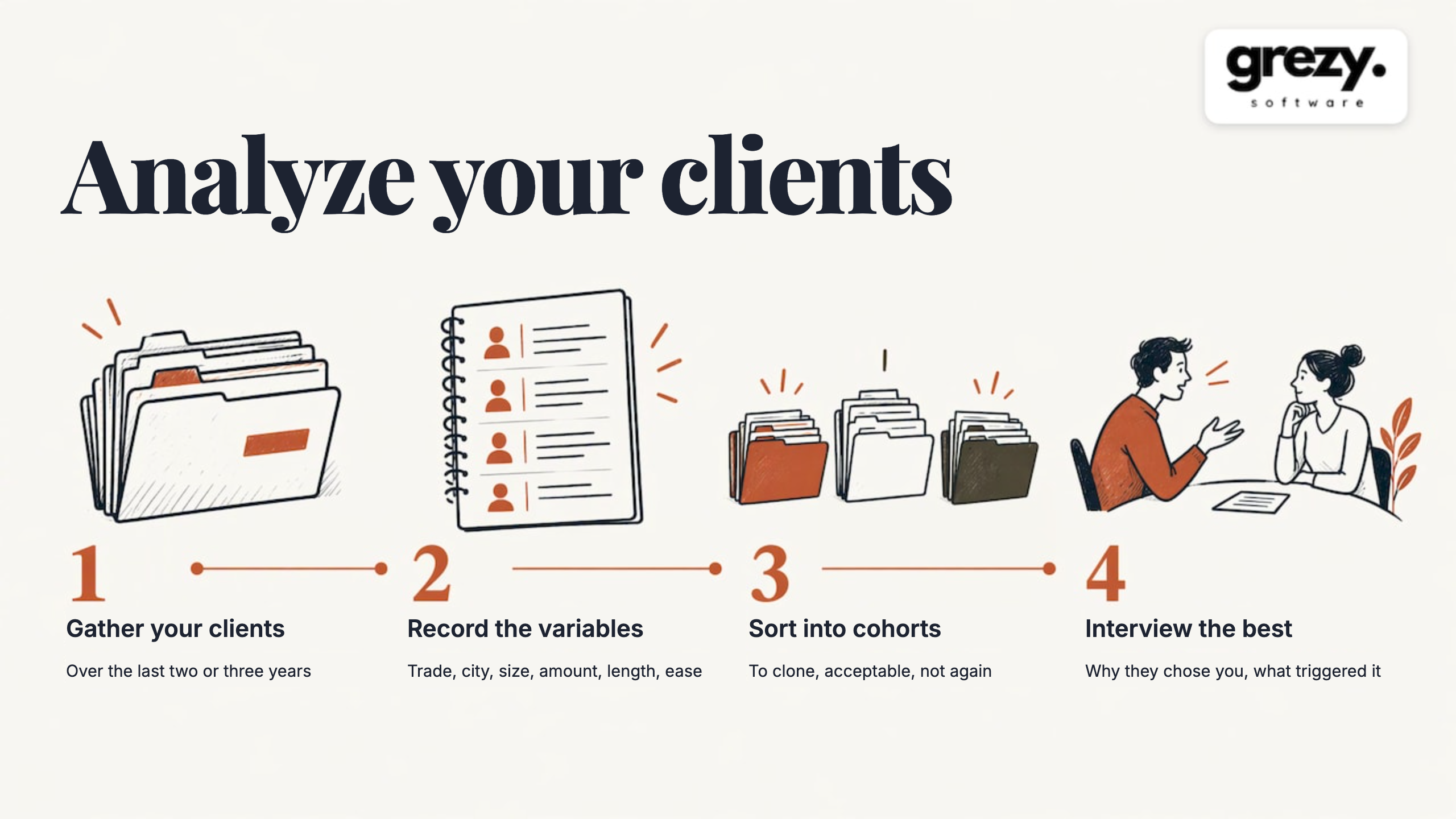
1. List your clients and rank them
Gather every client from the last two or three years. For each, record: trade, city, size, amount billed, relationship length, ease of collaboration. Sort them into three groups: those you would clone, the acceptable ones, those you would not take again.
This cohort logic is what Stéphane Bergé, a RevOps consultant, describes: compare won, average, and lost clients variable by variable. He applies it to software vendors with dozens of contracts; an agency often has fewer clients. In that case, add a few conversations with your best clients: why did they choose you, what triggered their request?
2. Find what your best clients have in common
Look beyond the obvious. The criterion that separates good from bad clients is not always sector or size. For a WordPress freelancer, it might be “owner who answers the phone personally”; for a Google Ads agency, “company already taking quotes online.” One well-identified differentiator beats ten vague criteria.
3. Write the ICP in one sentence, then as criteria
Example sentence: “Proximity service businesses with 3 to 20 employees in Lyon, whose site is over five years old and who do not invest in local ads.” Then break it into criteria: mandatory, desirable, exclusions. If your ICP does not fit on half a page, it is too broad.
4. Pair a persona
For each ICP, one persona: who decides, their vocabulary, which objection keeps coming back. Prospecting copy is written for that person, not for “the company.”
5. Test on a limited wave
Contact a sample, measure replies and meetings booked, then tighten. An ICP is a hypothesis until it produces meetings.
Using your ICP to prospect
Once the ICP is written, it serves at three moments.
To build the list. You combine trade, city, size, and need signals. Manual work (scrolling Google Maps, opening each site, finding the owner’s email) takes hours per ten leads: that is the bottleneck for most agencies.
To qualify. Each lead is compared to the ICP. Those who meet all mandatory criteria go first; those hitting an exclusion are dropped.
To write. The message rests on the observed flaw: “your site takes more than x seconds to load on mobile,” “your Google listing has few reviews.” The opener is a diagnosis, not an agency pitch.
A method tip: cap each send wave, watch replies, and adjust the ICP from feedback. If “no” always comes from the same type of company, that type leaves the ICP.
When to update your ICP
The ICP is not set in stone. Personæ recommends reviewing it at least once a year or when the market shifts, and personas more often, every quarter. For an agency, realistic triggers include:
- you launch a new offer (local SEO, GEO, social ads);
- your last three clients no longer match your ICP;
- a trade or city is saturated with outreach;
- your response rate drops on a target that used to work.
Keep a small dashboard: leads contacted, replies, meetings, signed deals, by ICP segment. In a few lines it shows where your target is right and where it is too broad.
Promo: from ICP to a list ready to contact
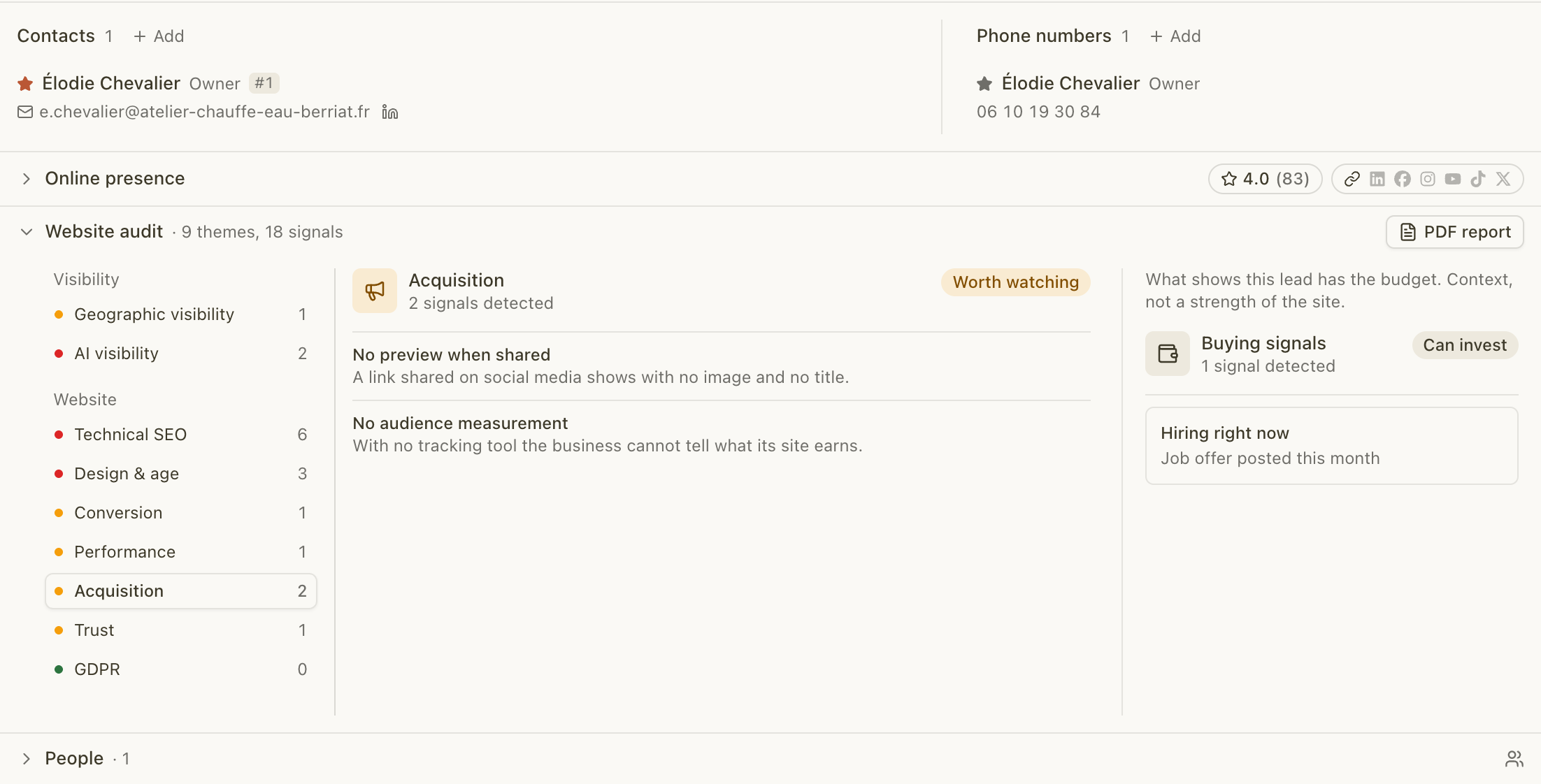
Once your ICP is written, the heavy part starts: finding companies, auditing their online presence, finding the owner, writing copy. AutoLeads, Grezy’s tool, handles that: you pick a trade and a city, it finds those businesses in real time on the web and Google Maps, audits their site, SEO, ads, and Google reviews, then enriches each lead with contacts (owner, email, phone, LinkedIn when found). It then drafts a sequence of emails and LinkedIn messages based on flaws found, with weekly send waves from your mailboxes or export to Lemlist, HubSpot, or CSV.
Monthly plans are: Starter at €249 per month, Growth at €499 per month, and Scale at €899 per month, with credits consumed based on lead volume and enrichments enabled. An option, “We call for you,” handles booking meetings by phone. You can compare plans on the AutoLeads pricing page.
Grezy’s view
We see many agencies define a sharp ICP on a slide, then prospect with a bought, aging list. The ICP is useless if it does not become a list of real, current companies with visible need.
For an agency, the best ICP is one you can observe from the outside: a slow site, Google reviews with no reply, no advertising. Those are facts, not guesses, and they give your first message a reason to exist. That is AutoLeads logic: start from a trade and a city, note each company’s concrete flaws, and show up with a diagnosis rather than a brochure.
We believe agencies win by choosing clients instead of waiting for them. Word of mouth stays valuable, but it does not fill a calendar on demand. A precise ICP fed with fresh data does.
Tom
Frequently asked questions
Sources
- Personæ: ICP and personas, using them together in B2B(opens in a new tab) accessed November 25, 2026
- Stéphane Bergé: defining your ICP from existing clients(opens in a new tab) accessed November 25, 2026
- Insee: general introduction to NAF(opens in a new tab) accessed November 25, 2026