Social Media Audit: A Method to Win New Clients
How to run a social media and online reputation audit for a small business, and turn the findings into outreach that opens the door to new clients for your agency.

In short
- A social audit unfolds in six steps: inventory accounts, define goals, measure performance, read reputation, compare, then prioritize.
- Official French guidance recommends limiting yourself to two or three priority actions, each with an owner and a deadline.
- Reputation is read platform by platform: average rating, recent reviews, and the share of reviews the business has answered.
- For an agency, the audit serves twice: it structures the engagement, and it supplies the opening hook for a prospecting message.
- AutoLeads automates detection of gaps (website, SEO, advertising, Google reviews, social media) across hundreds of small businesses in a trade and city.
A social media audit reviews a company's accounts, content, audience, and reputation, then pulls out a handful of priority actions. For an agency or freelancer, it is also the strongest prospecting message you can send: show up at a small local business with what is actually wrong on its accounts, instead of yet another "we help businesses grow." The problem is time: manually auditing a hundred shops before writing to them is not sustainable. This article walks through the audit method step by step, then explains how to scale it so it fills your calendar.
What a social media audit really covers
To audit is to produce a quantified snapshot of what the company publishes, how its audience reacts, and what people say about it. Bpifrance Création presents this kind of diagnostic as a snapshot that helps spot priorities and organize maintenance or improvement actions. The keyword is "priorities": an audit that ends with thirty recommendations never gets implemented.
In practice, four blocks show up in every serious audit:
- Accounts: which profiles exist, which are active, which are abandoned or duplicated.
- Content: publishing cadence, formats, themes, posts that work and posts that drag down the average.
- Audience and engagement: followers and how they change, reach, interactions.
- Reputation: reviews, mentions, tone, and how responsive the business is.
For a small business, a fifth block matters just as much: consistency with the rest of the online presence. A polished Instagram account that links to a slow, dated website, or a Google listing with no replies to reviews, tells an incomplete story. That is where your mission lies as an agency.
The six steps of a social media audit
1. Inventory accounts and set the scope
Start by listing every company profile: Facebook, Instagram, LinkedIn, TikTok, YouTube, Google Business Profile. For each one, note the date of the last post, the display name, the bio link, and who owns the account. Omissions are common: a page created by a former intern, an account nobody can log into anymore.
Next, decide what deserves to be audited. FranceNum, the public program that helps businesses go digital, recommends choosing networks your target audience actually uses and that fit your goals, and advises newcomers to focus on one network, two at most. For a plumber, the Google listing and Facebook matter more than TikTok. For a restaurant, Instagram and Google come before LinkedIn.
2. Set the goal before you measure
An audit without a goal produces spreadsheets and no decisions. Ask one question per account: does it exist to drive calls, bookings, job applications, or local awareness? The same number (500 followers, 12 interactions per post) is good or bad depending on the answer.
3. Measure performance
The same official source lists baseline indicators: followers and how they change, reach, impressions, mentions, interactions, share of voice, and hashtag performance. For a small business audit, keep few numbers, but compare them over time:
| Metric | What it tells you | Common pitfall |
|---|---|---|
| Follower growth | Community momentum | Bought or inactive followers inflate the total |
| Reach and impressions | Real visibility of posts | Confusing visibility with interest |
| Interactions | Audience reaction | Comparing a local account to a national brand |
| Publishing cadence | Consistency | Ten posts in one week, then three months of silence |
| Top-performing posts | Formats and themes worth repeating | Deriving a rule from one viral post |
If you audit for a client, use at least the last three months, more if the business is seasonal (an ice cream shop, a campsite, a florist before Mother's Day).
4. Read online reputation
This is the part most audit templates rush through, and the one that resonates most with a small business owner, because it hits revenue directly. Bpifrance Création advises you to search the company name, brand, owner, and products, then also check image, video, and news tabs, social networks, blogs, forums, and review sites.
For reviews, FranceNum suggests recording, platform by platform, the average rating, the number of recent reviews, and the share of reviews the business has answered, then verifying listing accuracy (hours, address, phone). Without a tool, the same page suggests rereading the last 30 reviews and sorting them by theme: welcome, quality, delays, price, after-sales service.
Example: a restaurant in Bordeaux shows 4.2 on Google, but 9 out of 10 reviews from the last three months got no reply, and three mention wait times in the dining room. The takeaway is not "the rating is fine," it is "the recurring theme is delays, and nobody responds." That is an actionable observation.
5. Compare against local competitors
A number on its own means little. Pick three direct competitors from the same neighborhood or city and record the same metrics: frequency, formats, review count, replies. The gap versus the business next door is the most convincing argument you can show an owner.
6. Turn findings into an action plan
This step separates a useful audit from one more PDF. FranceNum recommends implementing two or three priority actions, each with an owner and a deadline. Rank initiatives by impact and effort, and write them like this: "reply to all reviews from the last 30 days, by the manager, within two weeks."
How often should you audit?
There is no official standard. Common practice ranges from a quick monthly check to a full annual audit, with quarterly or semiannual rhythm for fast-moving accounts. For a small business, a full audit once a year plus a light quarterly check (rating, review count, publishing cadence) is usually enough. Run another audit after a major change: website redesign, new vendor, a wave of negative reviews.
What the audit holds for an agency
For your own agency, the audit plays two distinct roles.
First role: the engagement. Whether paid or complimentary, the audit opens the relationship: it proves you looked at the business before reaching out, and it naturally leads to services (account management, local ads, website redesign, local SEO).
Second role: the commercial hook. A message like "Hello, I reviewed your online presence: your last post was eight months ago, 14 Google reviews have no reply, and your site takes several seconds to load" gets more responses than an agency pitch deck. It is verifiable, specific, and the owner can confirm it in two clicks.
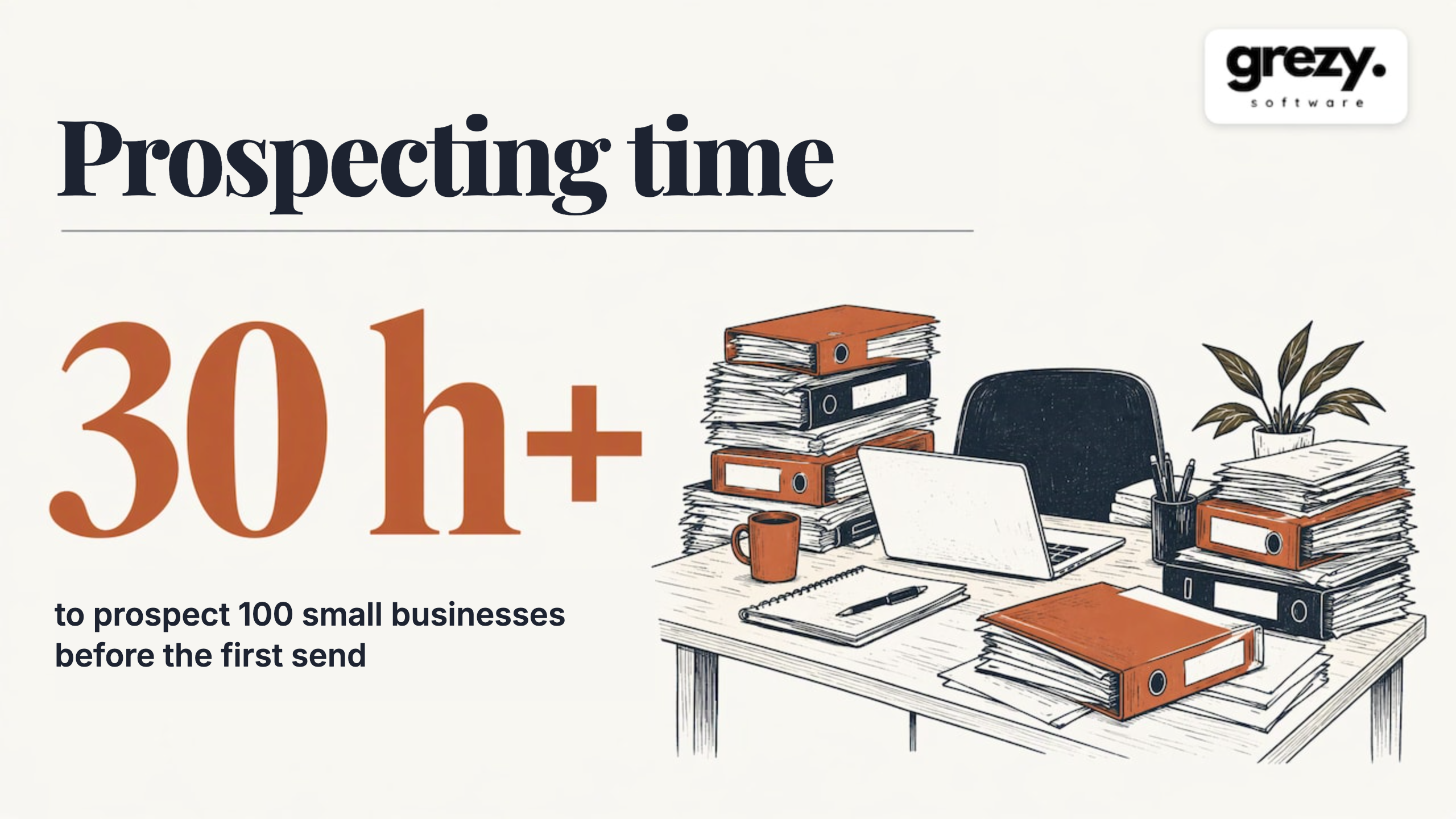
The real bottleneck is operational. To target "plumbers in Lyon," you need to find the businesses, locate their accounts, pull the metrics, identify the owner, find their email, and draft a message that references the gaps you found. At roughly twenty minutes per company, a list of 100 small businesses is more than thirty hours before the first send. Most agencies quit at that point and go back to word of mouth.
Auditing at scale without losing weeks
Manual audit remains the right method when you work a signed client. For prospecting, the stakes are different: quickly spot which businesses have a visible need, and write to them with that finding. That is exactly the problem AutoLeads was built to solve, as the next section explains.
AutoLeads: online presence audit, built into your prospecting
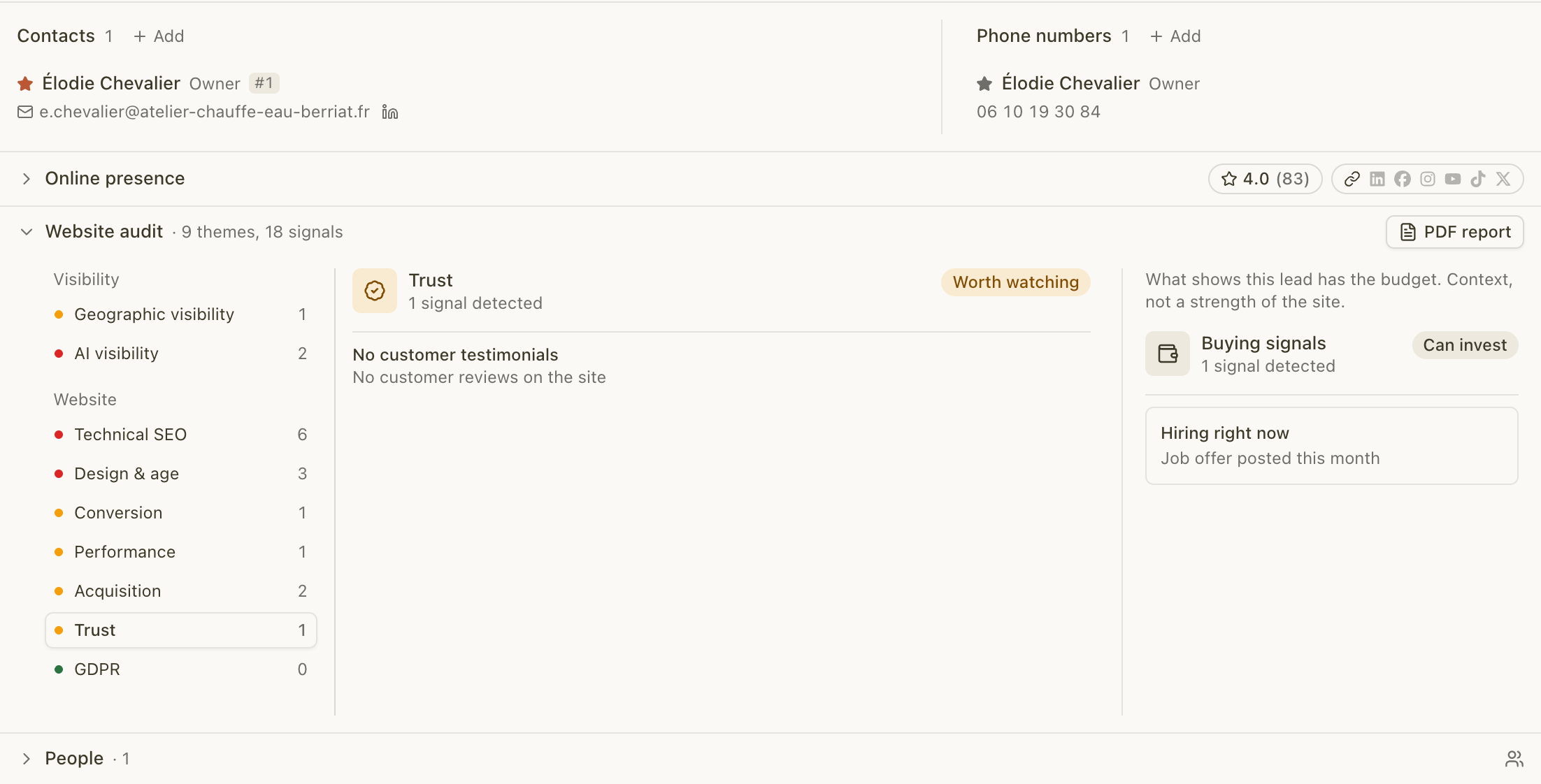
AutoLeads, Grezy's prospecting tool, works like this: you pick a trade and a city, for example "plumbers in Lyon" or "restaurants in Bordeaux." The tool finds those businesses in real time on the web and Google Maps, then audits their online presence: outdated or slow website, weak SEO, no advertising, Google reviews, social media.
Each lead is enriched with contacts (owner, email, phone, LinkedIn when found). For each business, AutoLeads drafts a sequence of emails and LinkedIn messages grounded in the gaps identified. You show up with a concrete diagnostic instead of a generic pitch.
Sends go out in weekly waves from your agency inboxes and accounts, or sync to Lemlist, HubSpot, or a CSV export. Replies land in a built-in CRM as tasks, and an à la carte option, "We call for you," lets you outsource appointment booking.
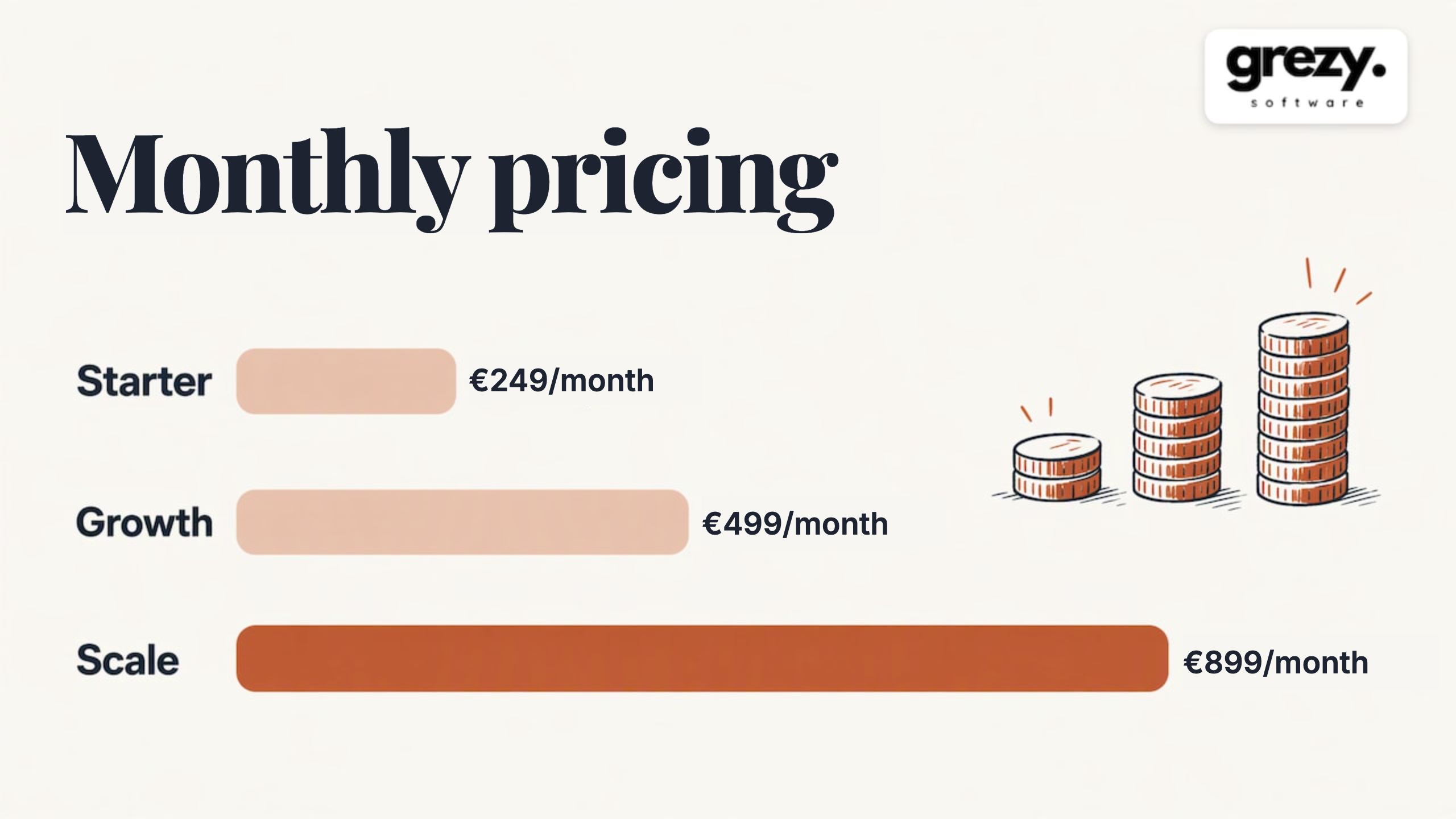
Monthly plans are published on the site: Starter at €249, Growth at €499, and Scale at €899 per month, with credits consumed based on lead volume and enrichments you enable.
What to do with the results: the debrief meeting
When an owner replies to your message, the next move is the debrief. Keep the action-plan logic described above:
- One finding per theme, quantified (unanswered reviews, date of last post, missing link on the profile).
- A local comparison with two or three competitors in the same sector.
- Two or three actions, each with an owner, a deadline, and a control metric.
- Your role: what you handle, what the client must do on their side (reply to reviews, supply photos).
A simple rule so you do not dilute the message: one gap highlighted in the email, three in the meeting, everything else in the written plan. If the owner has no time for social media, the right move is to show the gap versus competitors on a single number their customers care about: reviews and response time.
Our point of view
The agencies we meet rarely lack skill. They lack pipeline: the first contact. Relying on word of mouth, freelance platforms, or RFPs means waiting for demand to show up.
Yet the need is often already visible: a site that loads slowly, a Google listing with no replies, social accounts on pause. You just have to see it before others do and say it clearly. That is why we built AutoLeads around the audit: a message grounded in real gaps stands out from mass outreach.
We believe the audit is not a separate step to do "when we have time." It should go out with the first email, for every target business, and feed the conversation through to the meeting.
Alexis
Frequently asked questions
Sources
- Bpifrance Création, E-reputation: 9 tips to polish your image(opens in a new tab) accessed November 26, 2026
- FranceNum, How to use social media to get known(opens in a new tab) accessed November 26, 2026
- FranceNum, Customer reviews: why and how to analyze reputation(opens in a new tab) accessed November 26, 2026